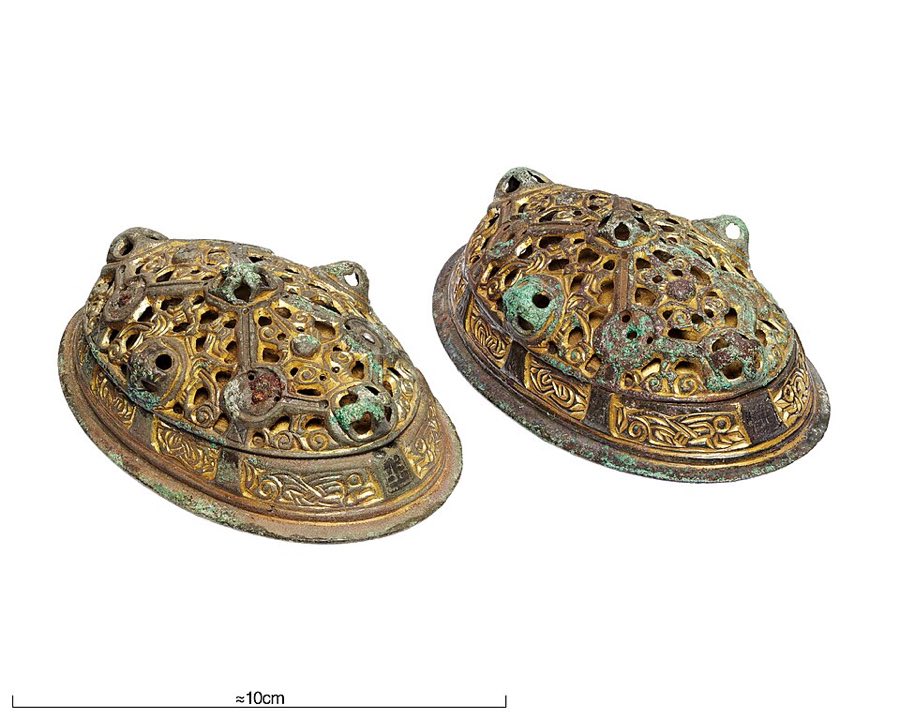

Brooch · Early Medieval
Viking oval brooch
800–1000 CE, Viking
Oval brooches held up the straps of the Scandinavian woman's apron dress and are found wherever Norse women settled, from Iceland and Ireland to Russia. Petersen's types 37 and 51 are the commonest ninth- and tenth-century forms; the earlier single-shell Berdal brooches are rarer. The type died out around 1000 CE as dress fashions changed, so a pair of oval brooches is a reliable marker of a pagan-period female grave.
| Object | Brooch |
|---|---|
| Dates | 800–1000 CE |
| Period | Early Medieval |
| Cultures | Viking |
| Regions | Europe — Northern & British Isles, Europe — Western & Central, Central Asia & Steppe |
Diagnostic traits
A domed oval brooch of cast bronze about 90–110 mm long, worn in pairs, with openwork or gripping-beast ornament, bosses and often a double shell and gilding.
Identification
No other early medieval brooch is domed and oval; Anglo-Saxon saucer brooches are round and much smaller. Type 37 has a single shell with nine bosses and ribbed borders; type 51 has an openwork upper shell over a plain lower one. Baltic and Finnish oval brooches are later and flatter.
Reproductions and fakes
Modern reproductions for re-enactment are cast from originals and sold in pairs with new pins; genuine brooches have corroded iron pins and springs, textile remains on the back and wear on the bosses. Beware of single museum-quality pieces with no provenance from Scandinavia, where export requires a permit.
Cite this article
Stratum Strata. "Viking oval brooch" (Artifact type). Stratum Strata pack 2026.09, as of 2026-09-21. https://stratum.black/strata/types/viking-oval-brooch. Accessed 2026-09-21.
@misc{stratum-viking-oval-brooch,
  title        = {Viking oval brooch},
  author       = {{Stratum Strata}},
  howpublished = {\url{https://stratum.black/strata/types/viking-oval-brooch}},
  year         = {2026},
  note         = {Artifact type article, Stratum Strata pack 2026.09, as of 2026-09-21; sources: stratum, commons. Accessed 2026-09-21.}
}
Citations carry the pack version and the article's as-of date so they resolve to the same text later. The facts themselves belong to the sources listed below; cite those for the science.