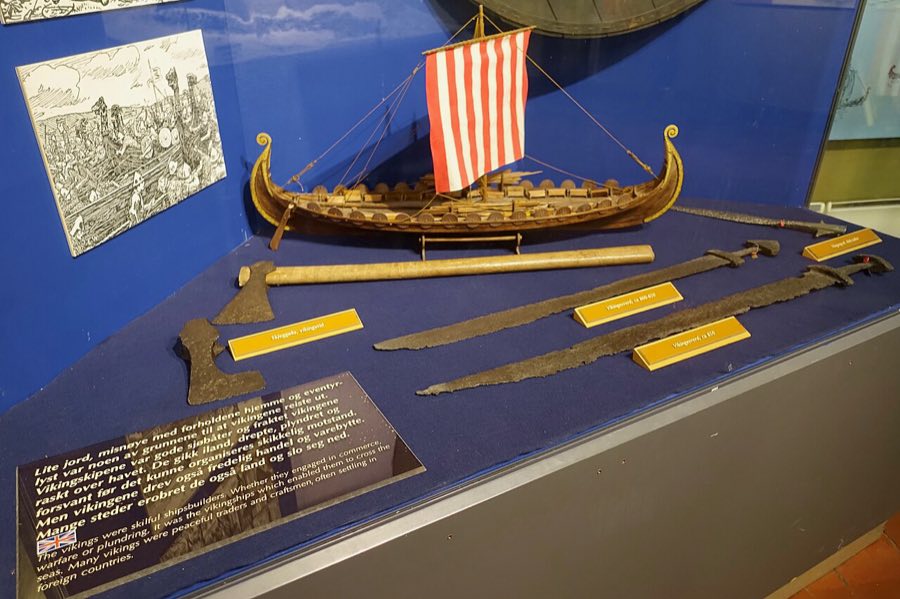

Axe head · Early Medieval
Viking axe head
800–1100 CE, Viking
The Viking axe head is the iron axe of Scandinavia and the Viking world from about 800 to 1,100 CE, ranging from small bearded work axes to the broad Dane axe of warriors. Petersen's typology letters A through M date them. Axes come from Scandinavian graves and from rivers and settlements in the British Isles and Baltic.
| Object | Axe head |
|---|---|
| Dates | 800–1100 CE |
| Period | Early Medieval |
| Cultures | Viking |
| Regions | Europe — Northern & British Isles |
Diagnostic traits
Iron axe with a broad, thin, flaring blade (bearded or Dane axe forms) and a narrow neck; classified by Petersen letters.
Identification
Viking axes have a thin, flaring blade with a narrow neck and often a beard, unlike Bronze Age socketed axes and later medieval axes with lugs; Petersen types define profile and eye shape. Some have inlaid silver. Iron is laminated and often corroded.
Reproductions and fakes
The most faked Viking object, both as modern forgings and as Eastern European medieval axes relabelled; genuine axes show laminated corrosion, a wood-filled eye and ancient damage. Uniform black surfaces indicate modern work.
Cite this article
Stratum Strata. "Viking axe head" (Artifact type). Stratum Strata pack 2026.09, as of 2026-09-21. https://stratum.black/strata/types/viking-axe-head. Accessed 2026-09-21.
@misc{stratum-viking-axe-head,
  title        = {Viking axe head},
  author       = {{Stratum Strata}},
  howpublished = {\url{https://stratum.black/strata/types/viking-axe-head}},
  year         = {2026},
  note         = {Artifact type article, Stratum Strata pack 2026.09, as of 2026-09-21; sources: stratum, commons. Accessed 2026-09-21.}
}
Citations carry the pack version and the article's as-of date so they resolve to the same text later. The facts themselves belong to the sources listed below; cite those for the science.