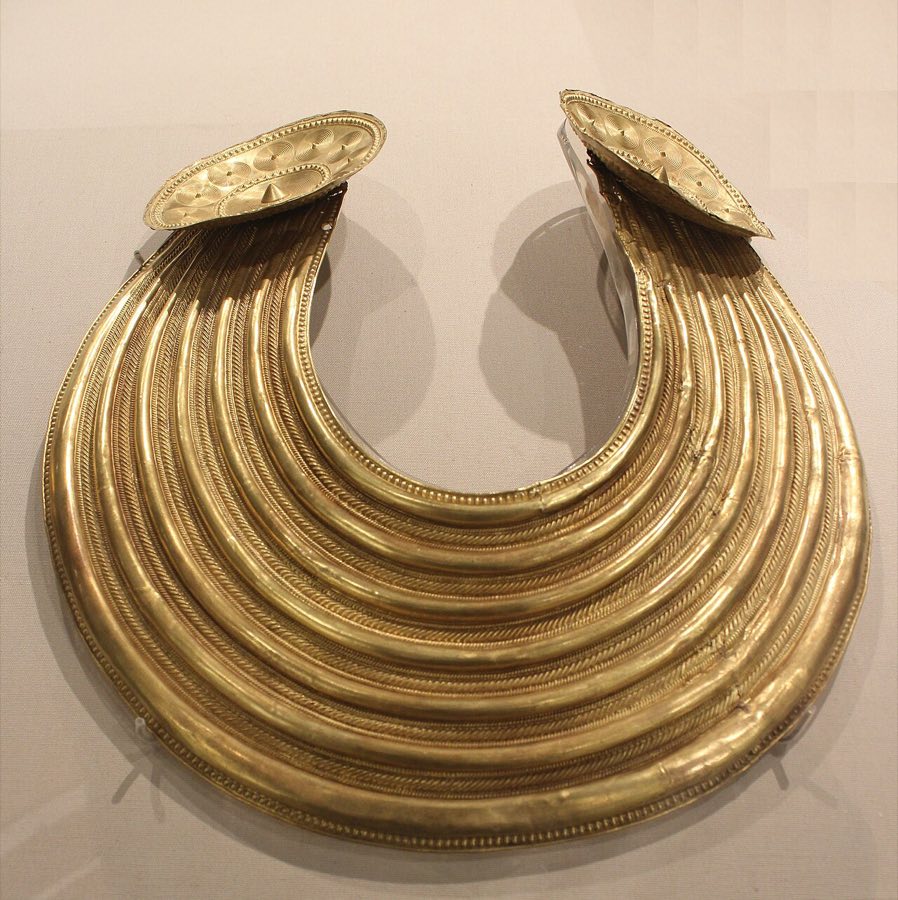

Gorget · Early Woodland
Two-hole gorget
1000 BCE–500 CE, Adena
The two-hole gorget is a flat drilled ground-stone ornament of the Early and Middle Woodland Eastern Woodlands, about 1,000 BCE to 500 CE, particularly associated with Adena burials. It was worn on the chest or used as an atlatl weight. Banded slate examples are the classic form.
| Object | Gorget |
|---|---|
| Dates | 1000 BCE–500 CE |
| Period | Early Woodland |
| Cultures | Adena |
| Regions | North America — Eastern Woodlands |
Diagnostic traits
Flat rectangular, expanded-centre or reel-shaped slate plaque with two biconically drilled holes.
Identification
Two-hole gorgets are flat rectangular, expanded-centre or reel-shaped slate plaques with two biconically drilled holes, unlike pendants, which have one hole, and bannerstones, which are drilled through the thickness. Reel-shaped forms are Adena; boat-shaped and semi-keeled forms are Archaic. Holes show incremental rings.
Reproductions and fakes
Gorgets are faked from modern slate and drilled with rotary tools; genuine holes are biconical with rings and the polish follows the banding. Tally marks along edges are also added to genuine plain gorgets to raise value.
Cite this article
Stratum Strata. "Two-hole gorget" (Artifact type). Stratum Strata pack 2026.09, as of 2026-09-21. https://stratum.black/strata/types/two-hole-gorget. Accessed 2026-09-21.
@misc{stratum-two-hole-gorget,
  title        = {Two-hole gorget},
  author       = {{Stratum Strata}},
  howpublished = {\url{https://stratum.black/strata/types/two-hole-gorget}},
  year         = {2026},
  note         = {Artifact type article, Stratum Strata pack 2026.09, as of 2026-09-21; sources: stratum, commons. Accessed 2026-09-21.}
}
Citations carry the pack version and the article's as-of date so they resolve to the same text later. The facts themselves belong to the sources listed below; cite those for the science.