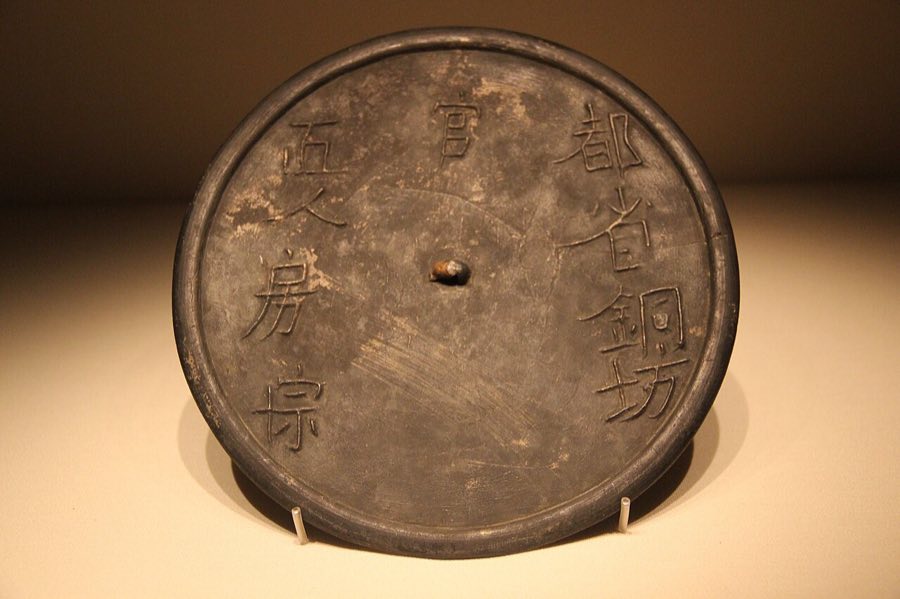

Mirror · Tang
Tang bronze mirror
618–907 CE, Imperial China
Tang mirrors are the most sculptural of Chinese mirrors, with the lion-and-grapevine design of the seventh and eighth centuries, foliate eight-lobed mirrors with birds and flowers, and luxury versions inlaid with gold and silver sheet or mother-of-pearl. They were court gifts and burial goods and are thinner and more silvery than Han mirrors. Many came west in the early twentieth century and are widely traded.
| Object | Mirror |
|---|---|
| Dates | 618–907 CE |
| Period | Tang |
| Cultures | Imperial China |
| Regions | East Asia |
Diagnostic traits
A cast high-tin bronze mirror, round, lobed or square, 80–250 mm across, with a domed central boss and high-relief decoration of lions and grapevines, phoenixes, flowers or auspicious animals on the back.
Identification
The Han bronze mirror is flatter, with a small boss and inscriptions or TLV patterns in low relief; Tang mirrors have high relief, a large boss and often a lobed outline. Song and later mirrors are thinner, often with handles and shop marks. The silvery colour comes from the tin-rich alloy, not plating.
Reproductions and fakes
Modern casts from originals are very common; they show a dull, soft relief, casting pits and an applied green or black patina that lacks the layered silvery-grey and green of the originals. A genuine mirror's polished face carries fine scratches and a mottled tin-rich surface.
Cite this article
Stratum Strata. "Tang bronze mirror" (Artifact type). Stratum Strata pack 2026.09, as of 2026-09-21. https://stratum.black/strata/types/tang-bronze-mirror. Accessed 2026-09-21.
@misc{stratum-tang-bronze-mirror,
  title        = {Tang bronze mirror},
  author       = {{Stratum Strata}},
  howpublished = {\url{https://stratum.black/strata/types/tang-bronze-mirror}},
  year         = {2026},
  note         = {Artifact type article, Stratum Strata pack 2026.09, as of 2026-09-21; sources: stratum, commons. Accessed 2026-09-21.}
}
Citations carry the pack version and the article's as-of date so they resolve to the same text later. The facts themselves belong to the sources listed below; cite those for the science.