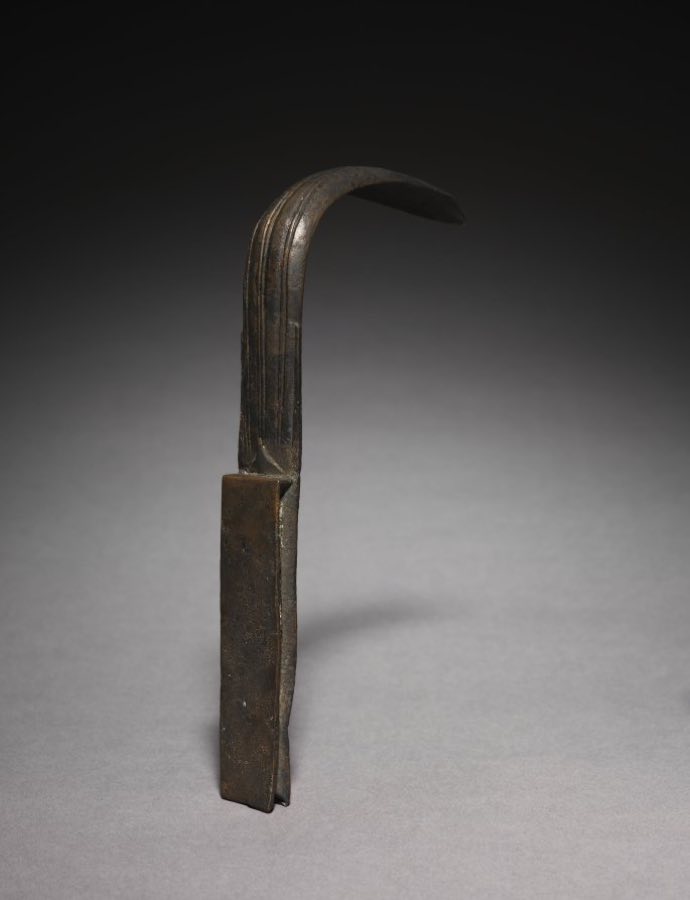
Strigil · Roman Empire
Strigil
500 BCE–400 CE, Roman, Ancient Greece
The strigil is the curved bronze scraper used by Greek and Roman athletes and bathers to remove oil and sweat, from about 500 BCE to 400 CE. It was hung from a ring with an oil flask and placed in graves and votive deposits. Bronze examples with inscribed handles are common in collections.
| Object | Strigil |
|---|---|
| Dates | 500 BCE–400 CE |
| Period | Roman Empire |
| Cultures | Roman, Ancient Greece |
| Regions | Europe — Mediterranean, Europe — Western & Central |
Diagnostic traits
Curved bronze scraper with a channelled blade and a handle, used to remove oil from the skin after exercise.
Identification
The channelled curved blade and looped handle are unmistakable; Greek examples have a longer handle and Roman ones a shorter, flat handle, sometimes stamped. Iron and silver examples exist. Wear at the blade edge is normal.
Reproductions and fakes
Reproduced and patinated; genuine strigils show stratified patina and wear in the channel. Restored handles are common.
Cite this article
Stratum Strata. "Strigil" (Artifact type). Stratum Strata pack 2026.09, as of 2026-09-21. https://stratum.black/strata/types/strigil. Accessed 2026-09-21.
@misc{stratum-strigil,
  title        = {Strigil},
  author       = {{Stratum Strata}},
  howpublished = {\url{https://stratum.black/strata/types/strigil}},
  year         = {2026},
  note         = {Artifact type article, Stratum Strata pack 2026.09, as of 2026-09-21; sources: stratum, cleveland. Accessed 2026-09-21.}
}
Citations carry the pack version and the article's as-of date so they resolve to the same text later. The facts themselves belong to the sources listed below; cite those for the science.