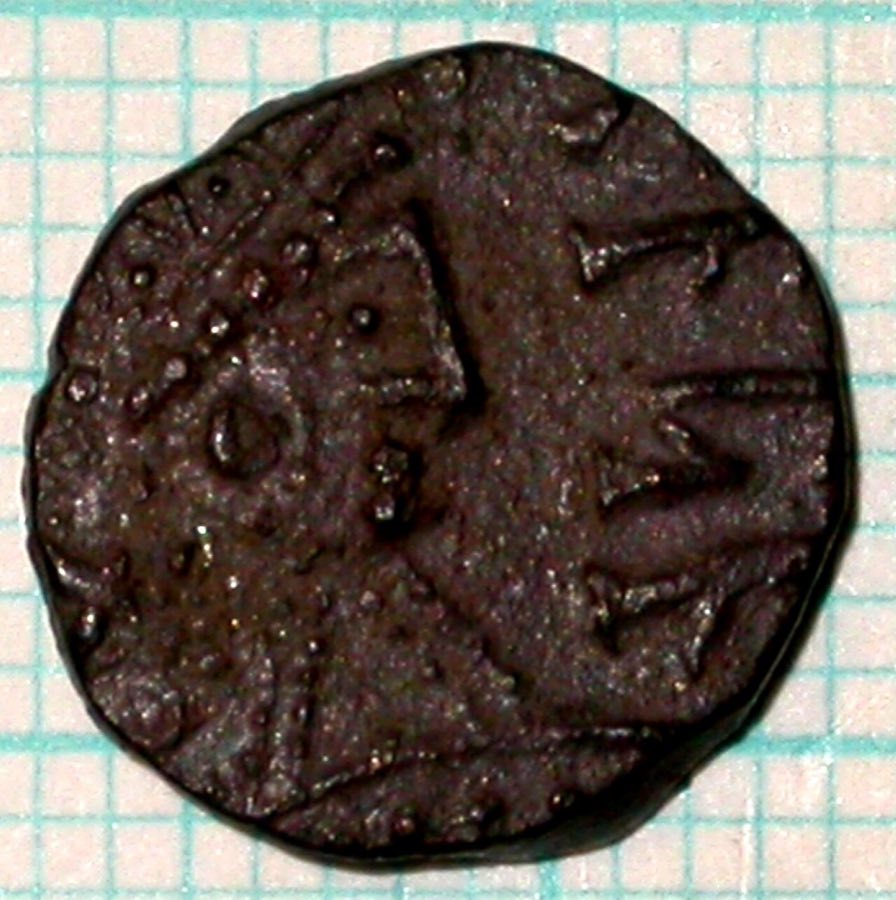

Coin · Early Medieval
Sceat
680–760 CE, Anglo-Saxon
Sceattas are the first substantial English silver coinage, struck from about 680 to 760 CE in Kent, London, East Anglia, Northumbria and the Frisian ports. The Primary series copy Roman and Merovingian models; the Secondary series (about 710–760) show a menagerie of birds, wolves, serpents and standing figures in a distinctive insular style. They are classified by series letters (A to Z) and are found in numbers at productive sites and coastal trading places.
| Object | Coin |
|---|---|
| Dates | 680–760 CE |
| Period | Early Medieval |
| Cultures | Anglo-Saxon |
| Regions | Europe — Northern & British Isles, Europe — Western & Central |
Diagnostic traits
A thick small silver coin about 10–13 mm across and 1 g in weight with a bust, bird, animal or geometric design in place of legends, struck in England and Frisia.
Identification
A sceat is smaller and thicker than the later broad penny of Offa and has no royal name; a Merovingian denier is similar in module but usually names a mint or moneyer. Northumbrian stycas are later, base copper, and carry a king's name. Series attributions follow Metcalf and the Fitzwilliam type corpus.
Reproductions and fakes
Cast copies in silver and pewter are known, especially of the porcupine and wolf-head types; genuine sceattas are struck, show flow lines and slightly off-centre designs, and often carry a grey tarnish rather than a green patina.
Elsewhere
- Wikidata: Q2723650
- Wikipedia: sceat
Cite this article
Stratum Strata. "Sceat" (Artifact type). Stratum Strata pack 2026.09, as of 2026-09-21. https://stratum.black/strata/types/sceat. Accessed 2026-09-21.
@misc{stratum-sceat,
  title        = {Sceat},
  author       = {{Stratum Strata}},
  howpublished = {\url{https://stratum.black/strata/types/sceat}},
  year         = {2026},
  note         = {Artifact type article, Stratum Strata pack 2026.09, as of 2026-09-21; sources: stratum, wikidata, commons. Accessed 2026-09-21.}
}
Citations carry the pack version and the article's as-of date so they resolve to the same text later. The facts themselves belong to the sources listed below; cite those for the science.