
Coin · Sasanian
Sasanian drachm
224–651 CE
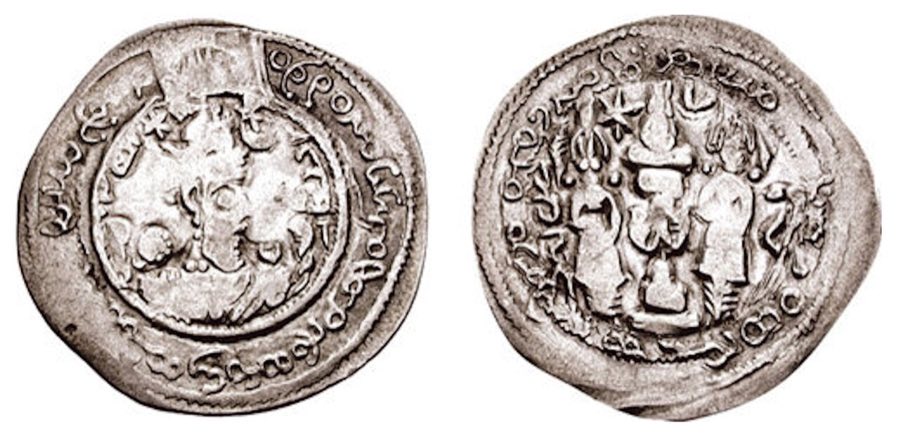
The Sasanian drachm is the thin, broad silver coin of the Persian empire from 224 to 651 CE, with the king's crowned bust and a fire altar flanked by attendants on the reverse. Each king has a distinct crown, and mint and regnal year appear in Pahlavi. It circulated across Iran and Mesopotamia and influenced early Islamic coinage.
| Object | Coin |
|---|---|
| Dates | 224–651 CE |
| Period | Sasanian |
| Regions | Near East & Mesopotamia, Central Asia & Steppe |
Diagnostic traits
Thin, broad silver coin with the king's crowned bust and a fire altar flanked by attendants; mint and year in Pahlavi.
Identification
The broad thin flan, crown form and fire altar distinguish it from Parthian drachms, which are thicker with an archer reverse, and from Arab-Sasanian issues with Arabic marginal legends. Khusro II drachms are the commonest. Weight is about 4 g.
Reproductions and fakes
Cast and struck fakes exist, especially of rarer kings; genuine drachms show striking cracks and a granular surface. Provenance matters as Iran and Iraq restrict export.
Cite this article
Stratum Strata. "Sasanian drachm" (Artifact type). Stratum Strata pack 2026.09, as of 2026-09-21. https://stratum.black/strata/types/sasanian-drachm. Accessed 2026-09-21.
@misc{stratum-sasanian-drachm,
  title        = {Sasanian drachm},
  author       = {{Stratum Strata}},
  howpublished = {\url{https://stratum.black/strata/types/sasanian-drachm}},
  year         = {2026},
  note         = {Artifact type article, Stratum Strata pack 2026.09, as of 2026-09-21; sources: stratum, commons. Accessed 2026-09-21.}
}
Citations carry the pack version and the article's as-of date so they resolve to the same text later. The facts themselves belong to the sources listed below; cite those for the science.