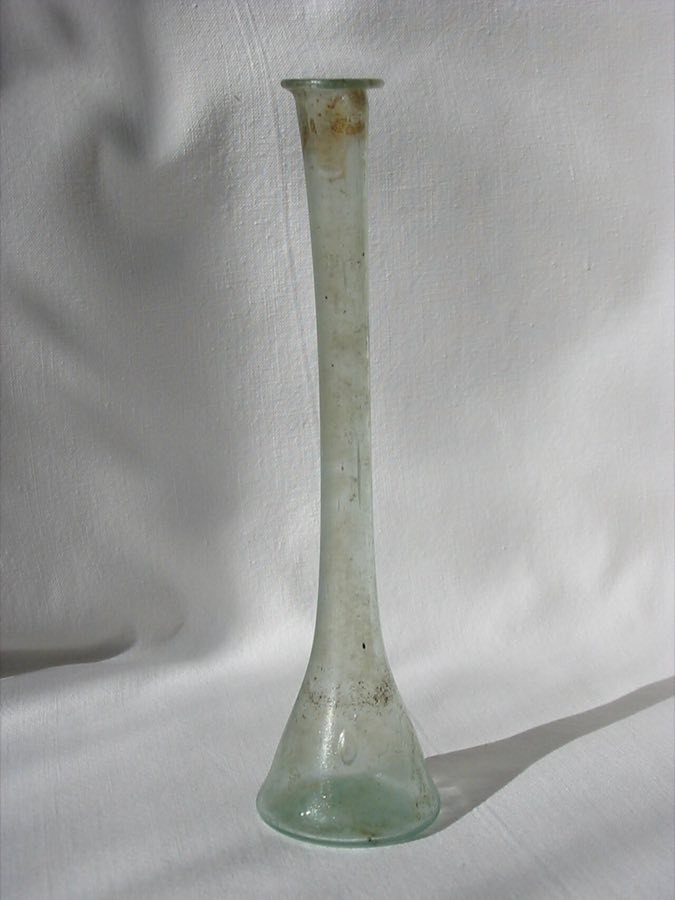

Glass vessel · Roman Empire
Roman glass unguentarium
50 BCE–300 CE, Roman
The Roman glass unguentarium is the small free-blown perfume or oil flask made across the empire from about 50 BCE to 300 CE, with a long tubular neck and a piriform, conical or candlestick body. Once called tear bottles, they were placed in graves in great numbers. It is the commonest Roman glass on the market.
| Object | Glass vessel |
|---|---|
| Dates | 50 BCE–300 CE |
| Period | Roman Empire |
| Cultures | Roman |
| Regions | Europe — Mediterranean, Europe — Western & Central, Near East & Mesopotamia, Egypt & Nile Valley |
Diagnostic traits
Small free-blown flask with a long tubular neck and a piriform, conical or candlestick body; thin greenish or bluish glass with iridescence.
Identification
Thin, free-blown greenish or bluish glass with a pontil mark and a flared rim distinguish it from ceramic unguentaria and from Hellenistic core-formed vessels; candlestick forms are later. Iridescence is weathering, not decoration. Sizes are 5 to 15 cm.
Reproductions and fakes
Reproduced in Egypt, Syria and Turkey with artificial iridescence and sometimes acid-etched surfaces; genuine weathering flakes in layers. Many market examples are genuine but from illicit grave-robbing in the Near East.
Cite this article
Stratum Strata. "Roman glass unguentarium" (Artifact type). Stratum Strata pack 2026.09, as of 2026-09-21. https://stratum.black/strata/types/roman-glass-unguentarium. Accessed 2026-09-21.
@misc{stratum-roman-glass-unguentarium,
  title        = {Roman glass unguentarium},
  author       = {{Stratum Strata}},
  howpublished = {\url{https://stratum.black/strata/types/roman-glass-unguentarium}},
  year         = {2026},
  note         = {Artifact type article, Stratum Strata pack 2026.09, as of 2026-09-21; sources: stratum, commons. Accessed 2026-09-21.}
}
Citations carry the pack version and the article's as-of date so they resolve to the same text later. The facts themselves belong to the sources listed below; cite those for the science.