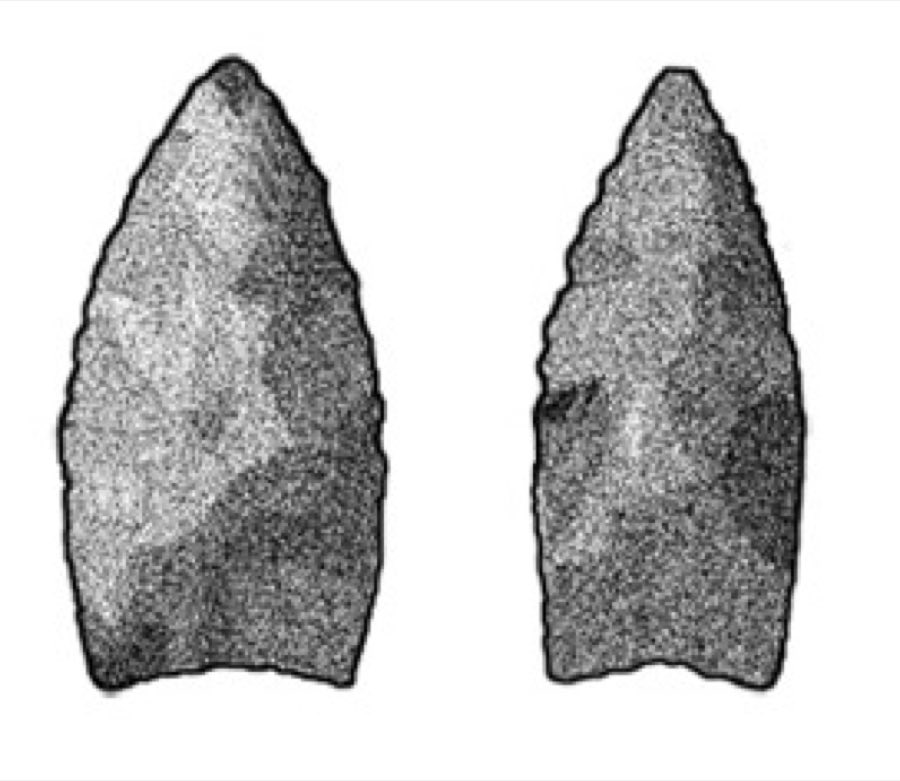

Projectile point · Paleoindian
Plainview
8000–7000 BCE, Plano
The Plainview point is an unfluted lanceolate of the Southern Plains and Southwest, about 8,000 to 7,000 BCE, named after a bison kill site in Texas. It resembles Clovis in outline but belongs to the later, unfluted tradition, and Goshen points of the Northern Plains are closely related. Most are in Edwards and Alibates chert.
| Object | Projectile point |
|---|---|
| Dates | 8000–7000 BCE |
| Period | Paleoindian |
| Cultures | Plano |
| Regions | North America — Great Plains, North America — Southwest |
Diagnostic traits
Unfluted lanceolate with parallel sides and a concave, basally thinned, ground base.
Identification
Plainview has parallel sides and a concave, basally thinned, ground base with no flutes, distinguishing it from Clovis, and lacks the stem of Scottsbluff. Flaking is parallel or collateral. Milnesand is a related form with a straight base.
Reproductions and fakes
Plainview is faked less than Clovis but Clovis fakes that failed to flute are sometimes sold as Plainview. Genuine points show basal grinding, heat-treatment gloss consistent with age and wear.
Elsewhere
- Wikidata: Q7200779
- Wikipedia: Plainview point
Cite this article
Stratum Strata. "Plainview" (Artifact type). Stratum Strata pack 2026.09, as of 2026-09-21. https://stratum.black/strata/types/plainview. Accessed 2026-09-21.
@misc{stratum-plainview,
  title        = {Plainview},
  author       = {{Stratum Strata}},
  howpublished = {\url{https://stratum.black/strata/types/plainview}},
  year         = {2026},
  note         = {Artifact type article, Stratum Strata pack 2026.09, as of 2026-09-21; sources: stratum, wikidata, commons. Accessed 2026-09-21.}
}
Citations carry the pack version and the article's as-of date so they resolve to the same text later. The facts themselves belong to the sources listed below; cite those for the science.