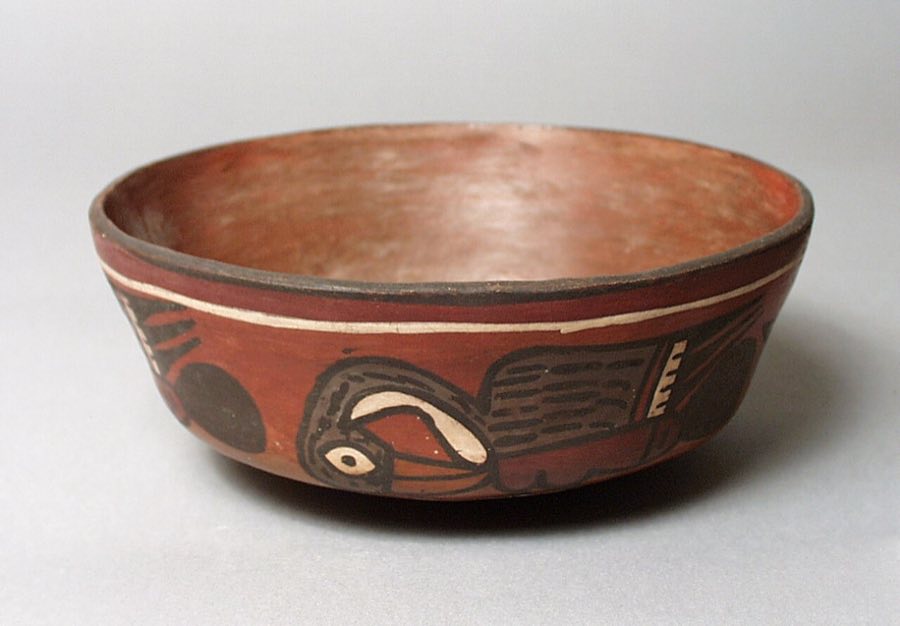

Bowl · Early Intermediate Period
Nazca polychrome bowl
100 BCE–700 CE, Nazca
The Nazca polychrome bowl is the thin-walled painted vessel of the south coast of Peru, about 100 BCE to 700 CE, slip-painted in up to a dozen colours before firing with mythical beings, birds, fish and plants. Nazca pottery is the most colourful in the ancient Americas. Bowls, double-spout bottles and effigies came from cemeteries.
| Object | Bowl |
|---|---|
| Dates | 100 BCE–700 CE |
| Period | Early Intermediate Period |
| Cultures | Nazca |
| Regions | South America — Andes |
Diagnostic traits
Thin-walled bowl with slip painting in up to a dozen colours showing mythical beings, birds and plants.
Identification
Nazca uses many slip colours including purple and grey fired together under a burnish, unlike Moche, which uses two, and Paracas, which paints resin colours after firing. Early phases are naturalistic and later ones proliferous and abstract. Walls are thin and surfaces glossy.
Reproductions and fakes
Faked with post-fired paints that are too bright and glossy, and genuine plain vessels are repainted; matte, integral slip and wear on the base indicate age. Restoration is routine and should be disclosed.
Cite this article
Stratum Strata. "Nazca polychrome bowl" (Artifact type). Stratum Strata pack 2026.09, as of 2026-09-21. https://stratum.black/strata/types/nazca-polychrome-bowl. Accessed 2026-09-21.
@misc{stratum-nazca-polychrome-bowl,
  title        = {Nazca polychrome bowl},
  author       = {{Stratum Strata}},
  howpublished = {\url{https://stratum.black/strata/types/nazca-polychrome-bowl}},
  year         = {2026},
  note         = {Artifact type article, Stratum Strata pack 2026.09, as of 2026-09-21; sources: stratum, commons. Accessed 2026-09-21.}
}
Citations carry the pack version and the article's as-of date so they resolve to the same text later. The facts themselves belong to the sources listed below; cite those for the science.