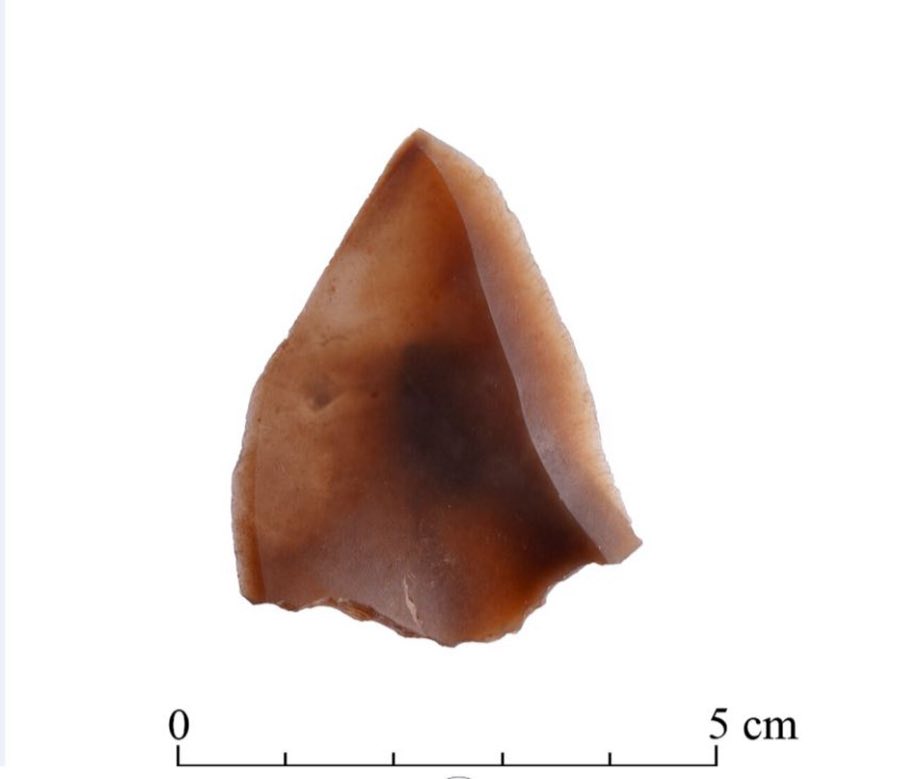

Projectile point · Middle Palaeolithic
Levallois point
300000–40000 BCE, Mousterian
The Levallois point is a triangular flake struck in one blow from a prepared core, the hallmark of Mousterian technology of Neanderthals and early modern humans from about 300,000 to 40,000 years ago in Europe and the Near East. It served as a spear tip or knife. Examples come from French, British and Levantine sites and from the Sahara.
| Object | Projectile point |
|---|---|
| Dates | 300000–40000 BCE |
| Period | Middle Palaeolithic |
| Cultures | Mousterian |
| Regions | Europe — Western & Central, Near East & Mesopotamia |
Diagnostic traits
Triangular flake struck in one blow from a prepared core; dorsal scars converge to the tip and the platform is faceted.
Identification
Levallois points show convergent dorsal scars from core preparation, a faceted striking platform and a thin, symmetrical outline, unlike bifacial handaxes and unlike Upper Palaeolithic blade points, which are struck from prismatic cores. Retouched examples become Mousterian points. Levallois flakes and cores are companions.
Reproductions and fakes
Easily replicated and sold with stains and light tumbling; genuine pieces have patina in the scars matching the surfaces and edge damage from sediment. Fresh glassy scars indicate modern work.
Elsewhere
- Wikidata: Q9020657
Cite this article
Stratum Strata. "Levallois point" (Artifact type). Stratum Strata pack 2026.09, as of 2026-09-21. https://stratum.black/strata/types/levallois-point. Accessed 2026-09-21.
@misc{stratum-levallois-point,
  title        = {Levallois point},
  author       = {{Stratum Strata}},
  howpublished = {\url{https://stratum.black/strata/types/levallois-point}},
  year         = {2026},
  note         = {Artifact type article, Stratum Strata pack 2026.09, as of 2026-09-21; sources: stratum, wikidata, commons. Accessed 2026-09-21.}
}
Citations carry the pack version and the article's as-of date so they resolve to the same text later. The facts themselves belong to the sources listed below; cite those for the science.