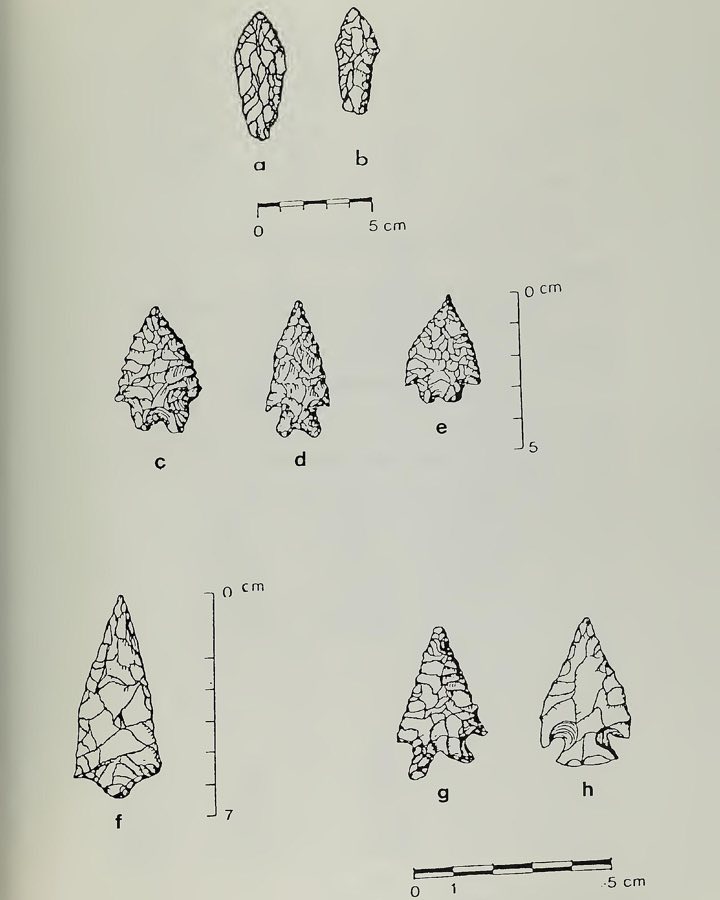

Projectile point · Paleoindian
Lake Mojave
10000–7000 BCE, Western Stemmed Tradition
Lake Mojave was named by Campbell and colleagues in 1937 from the fossil shorelines of Lake Mojave in San Bernardino County, California, and is the type point of the Western Stemmed or Western Pluvial Lakes tradition. It is found on playa margins across the Mojave and Great Basin. Obsidian, chalcedony and fine basalt are typical; desert varnish and wind polish are common.
| Object | Projectile point |
|---|---|
| Dates | 10000–7000 BCE |
| Period | Paleoindian |
| Cultures | Western Stemmed Tradition |
| Regions | North America — Great Basin & Plateau, North America — Pacific Coast, North America — Southwest |
Diagnostic traits
Long stemmed point with a stem that makes up half or more of the length, weak sloping shoulders, a rounded or pointed base, ground stem edges and a lenticular cross-section.
Identification
Lake Mojave has a longer, more gradually tapering stem than Silver Lake, whose stem is short and broad with distinct shoulders. Windust has a squarer base and stronger shoulders. Later Pinto and Gatecliff stems are unground.
Reproductions and fakes
Obsidian reproductions lack the hydration sheen and varnish of genuine desert surface finds; ground stem edges and differential weathering by face are the best signs of age.
Elsewhere
- Wikidata: Q138717642
Cite this article
Stratum Strata. "Lake Mojave" (Artifact type). Stratum Strata pack 2026.09, as of 2026-09-21. https://stratum.black/strata/types/lake-mojave. Accessed 2026-09-21.
@misc{stratum-lake-mojave,
  title        = {Lake Mojave},
  author       = {{Stratum Strata}},
  howpublished = {\url{https://stratum.black/strata/types/lake-mojave}},
  year         = {2026},
  note         = {Artifact type article, Stratum Strata pack 2026.09, as of 2026-09-21; sources: stratum, wikidata, commons. Accessed 2026-09-21.}
}
Citations carry the pack version and the article's as-of date so they resolve to the same text later. The facts themselves belong to the sources listed below; cite those for the science.