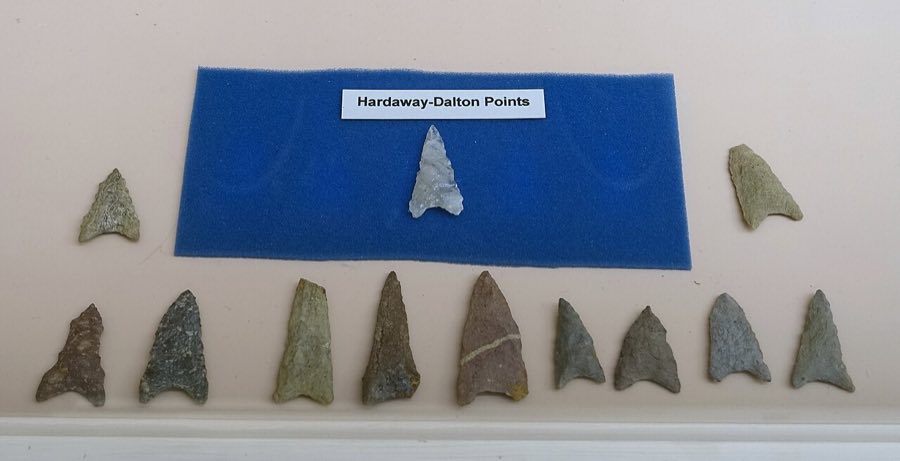

Projectile point · Paleoindian
Hardaway
8000–7000 BCE, Dalton
The Hardaway point is a Late Paleoindian to earliest Archaic form of the Carolina Piedmont and the Southeast, named after the Hardaway site in North Carolina and dated to about 8,000 to 7,000 BCE. It marks the transition from lanceolate to notched hafting. Most are in rhyolite from the Carolina Slate Belt.
| Object | Projectile point |
|---|---|
| Dates | 8000–7000 BCE |
| Period | Paleoindian |
| Cultures | Dalton |
| Regions | North America — Southeast |
Diagnostic traits
Broad, thin, with shallow side notches and a recurved concave base; basal ears and heavy grinding.
Identification
Hardaway is broad, thin and side-notched with a recurved, deeply concave base and basal ears, distinguishing it from Dalton which lacks notches and from Big Sandy which has a straighter, less recurved base. Grinding is heavy in the notches and base. Hardaway-Dalton and Palmer are the neighbouring forms in the Piedmont sequence.
Reproductions and fakes
Hardaway is not heavily faked because rhyolite is unattractive to reproducers, but Palmer and Kirk points are sometimes renotched to resemble it. Weathered rhyolite has a chalky rind that fresh flaking cuts through, which is a useful tell.
Cite this article
Stratum Strata. "Hardaway" (Artifact type). Stratum Strata pack 2026.09, as of 2026-09-21. https://stratum.black/strata/types/hardaway. Accessed 2026-09-21.
@misc{stratum-hardaway,
  title        = {Hardaway},
  author       = {{Stratum Strata}},
  howpublished = {\url{https://stratum.black/strata/types/hardaway}},
  year         = {2026},
  note         = {Artifact type article, Stratum Strata pack 2026.09, as of 2026-09-21; sources: stratum, commons. Accessed 2026-09-21.}
}
Citations carry the pack version and the article's as-of date so they resolve to the same text later. The facts themselves belong to the sources listed below; cite those for the science.