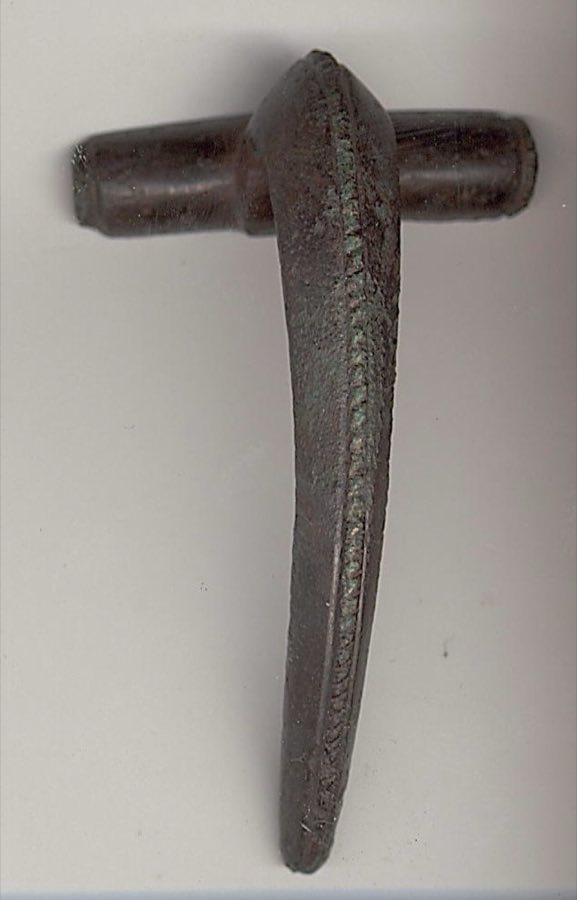

Brooch · Roman Empire
Dolphin brooch
50–150 CE, Roman
Dolphin brooches are the commonest brooch of first-century Roman Britain, derived from the Colchester type and made in the Midlands and south. Polden Hill brooches are the closely related series with a closed crossbar and a rearward hook for the chord. They are 40–70 mm long, usually undecorated except for grooves along the bow, and detectorists find them in great numbers.
| Object | Brooch |
|---|---|
| Dates | 50–150 CE |
| Period | Roman Empire |
| Cultures | Roman |
| Regions | Europe — Northern & British Isles |
Diagnostic traits
A Romano-British bronze bow brooch whose humped bow tapers in a fish-like curve to the foot, with a spring housed in a cylindrical crossbar and a small wing or crest at the head.
Identification
A Colchester brooch has an open spring with the chord held by a hook cast into the head; a dolphin has the spring enclosed in a crossbar and a more pronounced hump. The trumpet brooch that follows has a flared head and a central acanthus knop. Head-stud brooches have a stud on the bow and enamel panels.
Reproductions and fakes
Rarely faked because of low value, but composite brooches with replaced springs and pins are sold as intact; a genuine spring is corroded to the axis bar and the catchplate shows wear from the pin.
Elsewhere
- Wikidata: Q111700098
Cite this article
Stratum Strata. "Dolphin brooch" (Artifact type). Stratum Strata pack 2026.09, as of 2026-09-21. https://stratum.black/strata/types/dolphin-brooch. Accessed 2026-09-21.
@misc{stratum-dolphin-brooch,
  title        = {Dolphin brooch},
  author       = {{Stratum Strata}},
  howpublished = {\url{https://stratum.black/strata/types/dolphin-brooch}},
  year         = {2026},
  note         = {Artifact type article, Stratum Strata pack 2026.09, as of 2026-09-21; sources: stratum, wikidata, commons. Accessed 2026-09-21.}
}
Citations carry the pack version and the article's as-of date so they resolve to the same text later. The facts themselves belong to the sources listed below; cite those for the science.