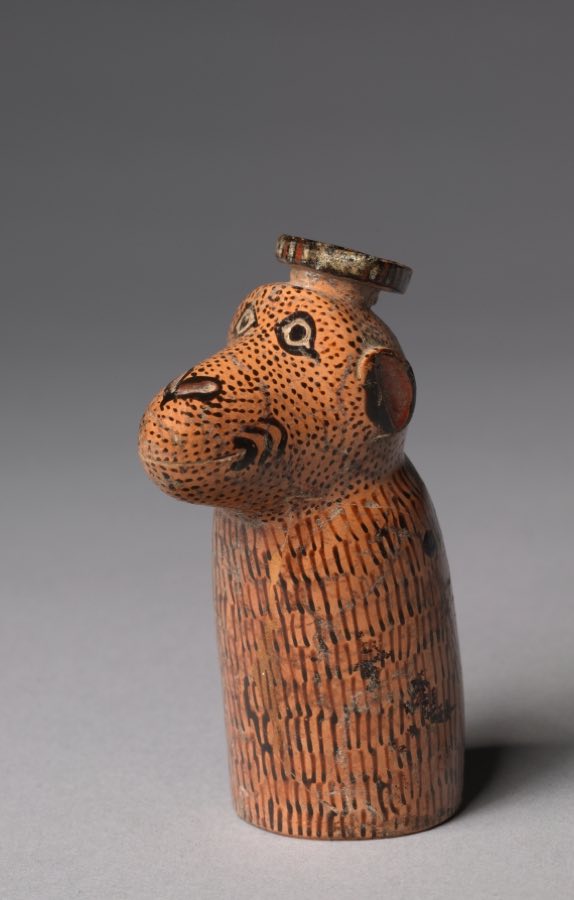
Vessel · Archaic Greek
Corinthian aryballos
720–550 BCE, Ancient Greece
Corinth's potters exported these oil flasks across the Mediterranean from the late eighth century to the mid sixth, first in the Protocorinthian piriform shape and later as round-bodied flasks crowded with lions, panthers, sirens and filler rosettes. They were athletes' oil bottles and grave gifts, and Etruscan tombs have yielded them in quantity. Aryballoi are among the cheapest complete Greek painted vases and a staple of dealers in Classical antiquities.
| Object | Vessel |
|---|---|
| Dates | 720–550 BCE |
| Period | Archaic Greek |
| Cultures | Ancient Greece |
| Regions | Europe — Mediterranean |
Diagnostic traits
A small globular or piriform perfume flask 50–90 mm high with a narrow neck and a broad flat disc mouth, painted in black-figure with animals, rosettes and incised detail on a pale buff clay.
Identification
The buff Corinthian clay and flat disc mouth are diagnostic; an Attic aryballos is red-clayed and rarer, an East Greek one is often a plain ring-shaped or figural vessel, and an alabastron is elongated with a rounded base. Protocorinthian flasks are tiny and finely drawn, while Late Corinthian quatrefoil aryballoi are mass-produced with a simple pattern.
Reproductions and fakes
Modern Greek and Italian copies are made in the right shape but with a thicker, pinkish fabric and paint that is brown rather than the fired black-to-red of the originals; genuine surfaces show root marks, flaking slip and a chalky lime deposit. Repainted and restored vessels are common, so examine under UV.
Cite this article
Stratum Strata. "Corinthian aryballos" (Artifact type). Stratum Strata pack 2026.09, as of 2026-09-21. https://stratum.black/strata/types/corinthian-aryballos. Accessed 2026-09-21.
@misc{stratum-corinthian-aryballos,
  title        = {Corinthian aryballos},
  author       = {{Stratum Strata}},
  howpublished = {\url{https://stratum.black/strata/types/corinthian-aryballos}},
  year         = {2026},
  note         = {Artifact type article, Stratum Strata pack 2026.09, as of 2026-09-21; sources: stratum, cleveland. Accessed 2026-09-21.}
}
Citations carry the pack version and the article's as-of date so they resolve to the same text later. The facts themselves belong to the sources listed below; cite those for the science.