
Coin · Han
Chinese cash coin
220 BCE–1912 CE, Imperial China
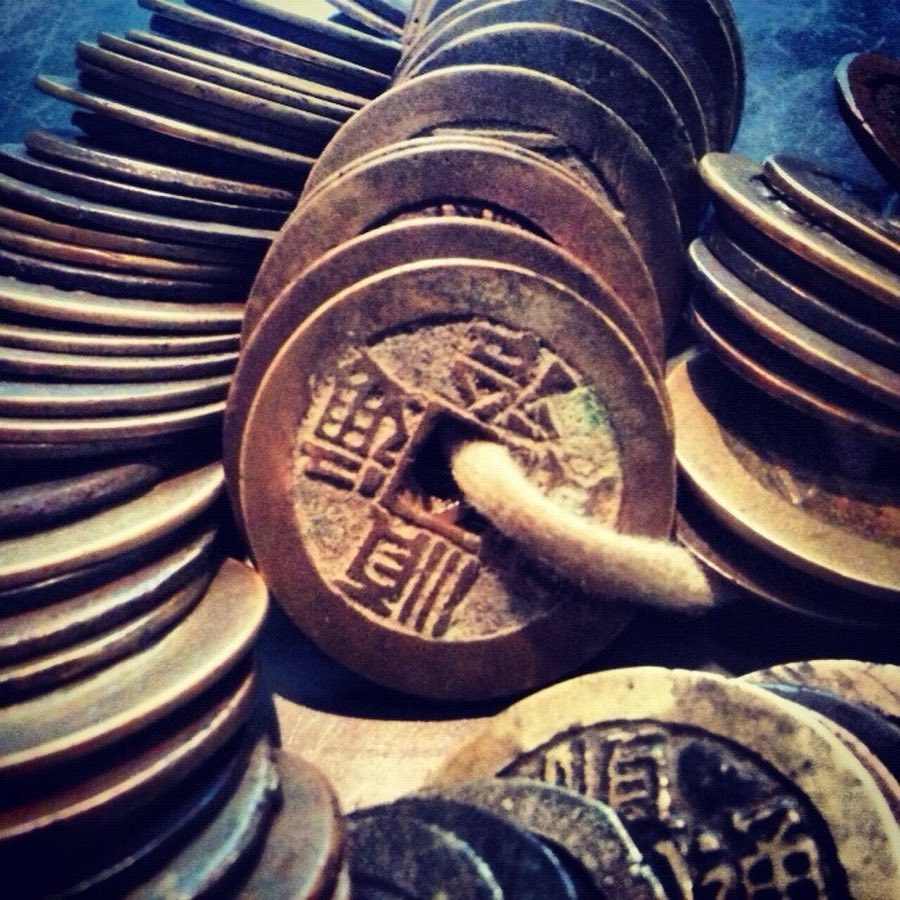
The Chinese cash coin is the cast round bronze coin with a square hole used from the Qin unification to 1912, bearing a four-character legend of reign title and denomination. It was strung in hundreds and served as the everyday currency of China, Japan, Korea and Vietnam. Millions survive and it is the entry-level Chinese antiquity.
| Object | Coin |
|---|---|
| Dates | 220 BCE–1912 CE |
| Period | Han |
| Cultures | Imperial China |
| Regions | East Asia |
Diagnostic traits
Cast round bronze coin with a square central hole and a four-character legend; strung in hundreds.
Identification
Cast, not struck, with a square hole and legend read top-bottom-right-left; Han wushu coins carry a weight legend, Tang Kaiyuan tongbao a reign title, and Qing coins Manchu mint marks on the reverse. Ban liang coins are earlier and plain. Diameter is about 24 mm.
Reproductions and fakes
Cast in bulk in modern China with fake patina; genuine coins have a crisp, hard patina and cast-in file marks on the rim. Rare types are the target of fakes.
Cite this article
Stratum Strata. "Chinese cash coin" (Artifact type). Stratum Strata pack 2026.09, as of 2026-09-21. https://stratum.black/strata/types/chinese-cash-coin. Accessed 2026-09-21.
@misc{stratum-chinese-cash-coin,
  title        = {Chinese cash coin},
  author       = {{Stratum Strata}},
  howpublished = {\url{https://stratum.black/strata/types/chinese-cash-coin}},
  year         = {2026},
  note         = {Artifact type article, Stratum Strata pack 2026.09, as of 2026-09-21; sources: stratum, commons. Accessed 2026-09-21.}
}
Citations carry the pack version and the article's as-of date so they resolve to the same text later. The facts themselves belong to the sources listed below; cite those for the science.