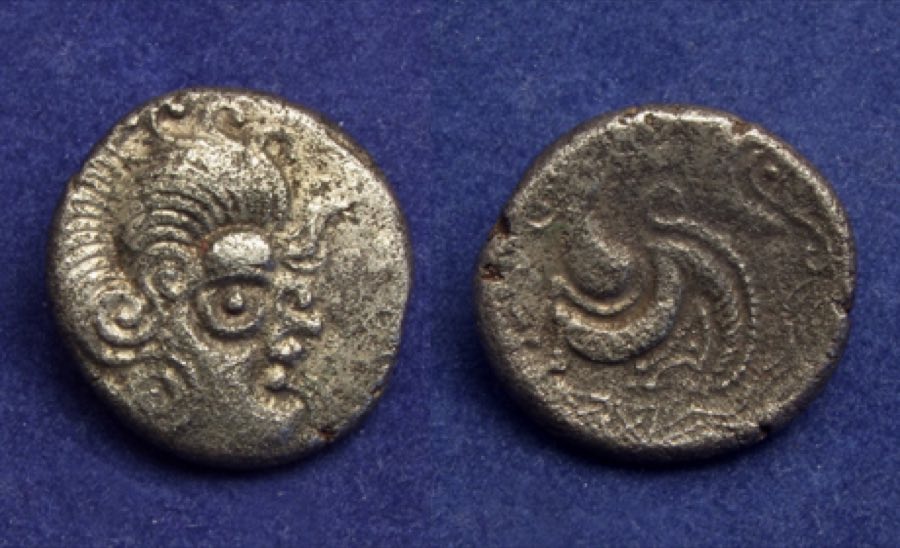

Coin · La Tène
Celtic stater
250–30 BCE, La Tène
Celtic tribes from the Danube to Britain copied Philip II's gold stater from the third century BCE, and the design dissolved into the famous abstract patterns of the Gallo-Belgic and British series. British uninscribed staters (Westerham, Whaddon Chase, Norfolk Wolf) precede the inscribed issues of Tasciovanus, Cunobelin and their rivals. Staters are the most valuable Iron Age coins routinely sold and are often found by metal detectorists in southern England.
| Object | Coin |
|---|---|
| Dates | 250–30 BCE |
| Period | La Tène |
| Cultures | La Tène |
| Regions | Europe — Western & Central, Europe — Northern & British Isles |
Diagnostic traits
A thick, slightly convex gold or base-gold coin about 15–20 mm across with a highly abstracted head of Apollo and a disjointed horse derived from the staters of Philip II of Macedon.
Identification
Quarter staters are the same designs at a quarter of the weight; silver units are smaller, thinner and from different tribes. Gallo-Belgic staters have a broader flan and higher relief than British ones, and uninscribed pieces are attributed by hoard evidence and stylistic series rather than legends. Weight (about 6 g for early, falling to about 5.5 g) and gold colour (paler and redder in later issues) help date them.
Reproductions and fakes
Cast copies in gold-coloured alloy with soft detail and a seam at the edge are widespread; also watch for modern pressed replicas sold as jewellery. Genuine staters are struck, with crisp raised detail, flow lines and a slightly irregular flan, and gold does not corrode.
Cite this article
Stratum Strata. "Celtic stater" (Artifact type). Stratum Strata pack 2026.09, as of 2026-09-21. https://stratum.black/strata/types/celtic-stater. Accessed 2026-09-21.
@misc{stratum-celtic-stater,
  title        = {Celtic stater},
  author       = {{Stratum Strata}},
  howpublished = {\url{https://stratum.black/strata/types/celtic-stater}},
  year         = {2026},
  note         = {Artifact type article, Stratum Strata pack 2026.09, as of 2026-09-21; sources: stratum, commons. Accessed 2026-09-21.}
}
Citations carry the pack version and the article's as-of date so they resolve to the same text later. The facts themselves belong to the sources listed below; cite those for the science.