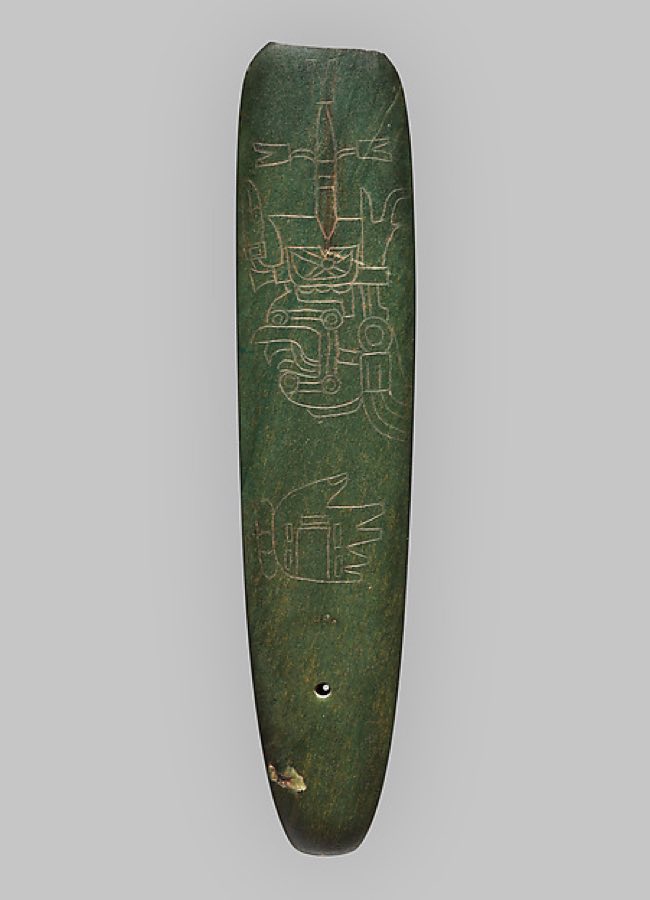
Celt · Mississippian
Celt
1000 BCE–1600 CE, Woodland (Eastern), Mississippian
The celt is the ungrooved polished stone axe head used across the Eastern Woodlands from the Woodland period through Mississippian times, about 1,000 BCE to 1,600 CE. It was hafted in a socketed handle and used for woodworking. Greenstone Mississippian examples are especially fine.
| Object | Celt |
|---|---|
| Dates | 1000 BCE–1600 CE |
| Period | Mississippian |
| Cultures | Woodland (Eastern), Mississippian |
| Regions | North America — Eastern Woodlands, North America — Southeast |
Diagnostic traits
Ungrooved polished stone axe head, tapering to the poll; Mississippian examples are often greenstone with a lenticular section.
Identification
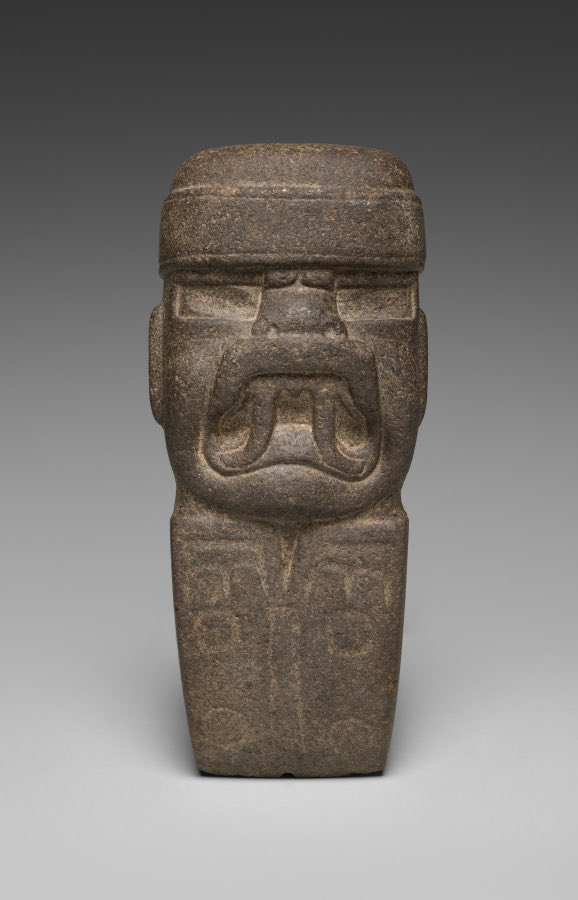
The celt has no groove and tapers to the poll, unlike the grooved axes; Mississippian examples are often greenstone with a lenticular section and a high polish, while Woodland celts are smaller and rougher. Spatulate and monolithic axes are ceremonial elaborations. Adzes have an asymmetric bit.
Reproductions and fakes
Celts are reproduced from river cobbles on power tools; genuine examples show pecking under the polish and use wear at the bit. Modern polish is uniform and glassy.
Photographs
Elsewhere
- met: 310467
Cite this article
Stratum Strata. "Celt" (Artifact type). Stratum Strata pack 2026.09, as of 2026-09-21. https://stratum.black/strata/types/celt. Accessed 2026-09-21.
@misc{stratum-celt,
  title        = {Celt},
  author       = {{Stratum Strata}},
  howpublished = {\url{https://stratum.black/strata/types/celt}},
  year         = {2026},
  note         = {Artifact type article, Stratum Strata pack 2026.09, as of 2026-09-21; sources: stratum, met, cleveland. Accessed 2026-09-21.}
}
Citations carry the pack version and the article's as-of date so they resolve to the same text later. The facts themselves belong to the sources listed below; cite those for the science.