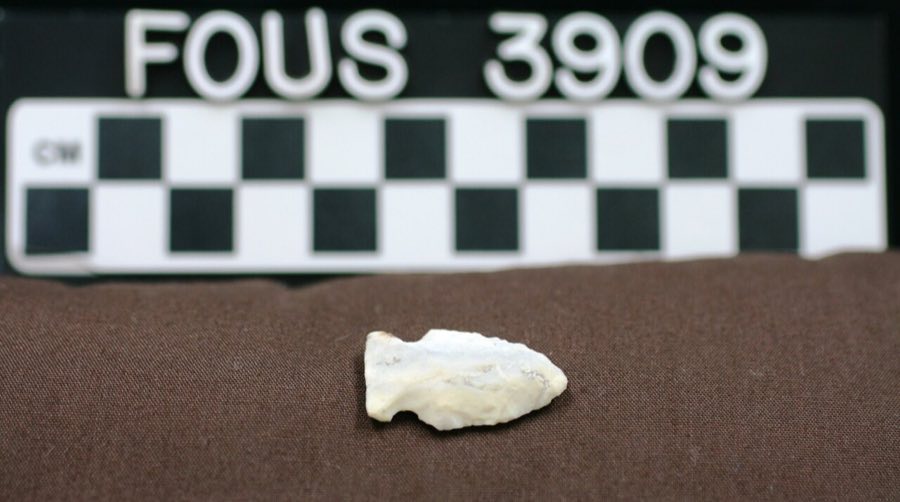

Projectile point · Late Archaic
Besant
100 BCE–500 CE, Plains Archaic
The Besant point is a side-notched dart point of the Northern Plains, about 100 BCE to 500 CE, associated with communal bison drives and pounds, and with the Sonota burial mounds of the Dakotas. It is often in Knife River flint traded widely. Besant persists after the bow appears with Avonlea.
| Object | Projectile point |
|---|---|
| Dates | 100 BCE–500 CE |
| Period | Late Archaic |
| Cultures | Plains Archaic |
| Regions | North America — Great Plains |
Diagnostic traits
Medium side-notched dart point with notches set low and close to a straight base; often Knife River flint.
Identification
Besant has notches set low near a straight base, a wide stem and a triangular blade, and is thicker and larger than Avonlea, which is a very thin arrowpoint; Pelican Lake is corner-notched with barbs. Some Besant points have a slightly concave base. Size is around 3 to 5 cm.
Reproductions and fakes
Besant points are reproduced by hobbyists in Knife River flint; genuine ones show patina in the notches and some edge wear. Fakes are usually too symmetrical.
Cite this article
Stratum Strata. "Besant" (Artifact type). Stratum Strata pack 2026.09, as of 2026-09-21. https://stratum.black/strata/types/besant. Accessed 2026-09-21.
@misc{stratum-besant,
  title        = {Besant},
  author       = {{Stratum Strata}},
  howpublished = {\url{https://stratum.black/strata/types/besant}},
  year         = {2026},
  note         = {Artifact type article, Stratum Strata pack 2026.09, as of 2026-09-21; sources: stratum, commons. Accessed 2026-09-21.}
}
Citations carry the pack version and the article's as-of date so they resolve to the same text later. The facts themselves belong to the sources listed below; cite those for the science.