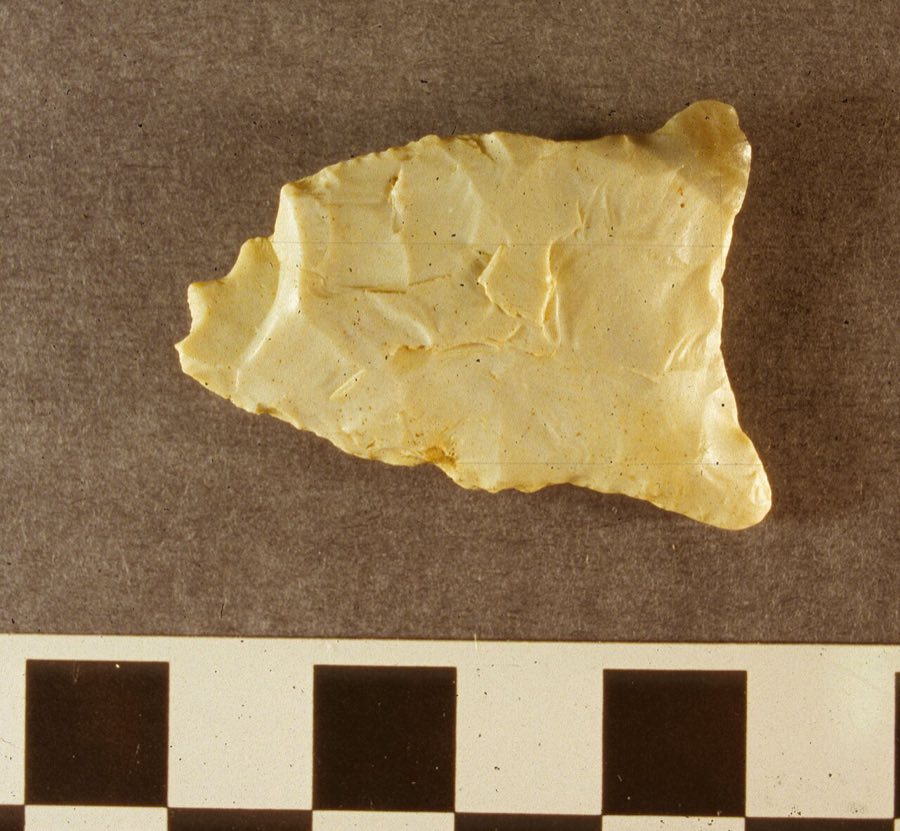

Projectile point · Paleoindian
Beaver Lake
10500–9500 BCE, Dalton
Beaver Lake was defined by Cambron and Hulse from Limestone County, Alabama, and is a late Paleoindian unfluted point of the Tennessee Valley and the mid-South. It is usually treated as a Dalton-cluster form slightly earlier than or overlapping classic Dalton. Fort Payne and Bangor chert are the common stones. Long unresharpened points are prized.
| Object | Projectile point |
|---|---|
| Dates | 10500–9500 BCE |
| Period | Paleoindian |
| Cultures | Dalton |
| Regions | North America — Southeast, North America — Eastern Woodlands |
Diagnostic traits
Slender lanceolate with recurved blade edges, a waist above the base, small rounded ears, a concave base thinned by short flakes, and grinding of the base and lower edges.
Identification
The recurved blade and narrow waist separate Beaver Lake from the wider, straight-edged Quad. Cumberland is fluted and more strongly eared. Dalton has serrated, beveled edges; Beaver Lake is unserrated and unbeveled.
Reproductions and fakes
Reproductions tend to be too symmetrical and thin; genuine pieces show basal grinding, patina consistent across the basal-thinning scars and often a slightly twisted, resharpened blade.
Elsewhere
- Wikidata: Q23130610
- Wikipedia: Beaver Lake point
Cite this article
Stratum Strata. "Beaver Lake" (Artifact type). Stratum Strata pack 2026.09, as of 2026-09-21. https://stratum.black/strata/types/beaver-lake. Accessed 2026-09-21.
@misc{stratum-beaver-lake,
  title        = {Beaver Lake},
  author       = {{Stratum Strata}},
  howpublished = {\url{https://stratum.black/strata/types/beaver-lake}},
  year         = {2026},
  note         = {Artifact type article, Stratum Strata pack 2026.09, as of 2026-09-21; sources: stratum, wikidata, commons. Accessed 2026-09-21.}
}
Citations carry the pack version and the article's as-of date so they resolve to the same text later. The facts themselves belong to the sources listed below; cite those for the science.