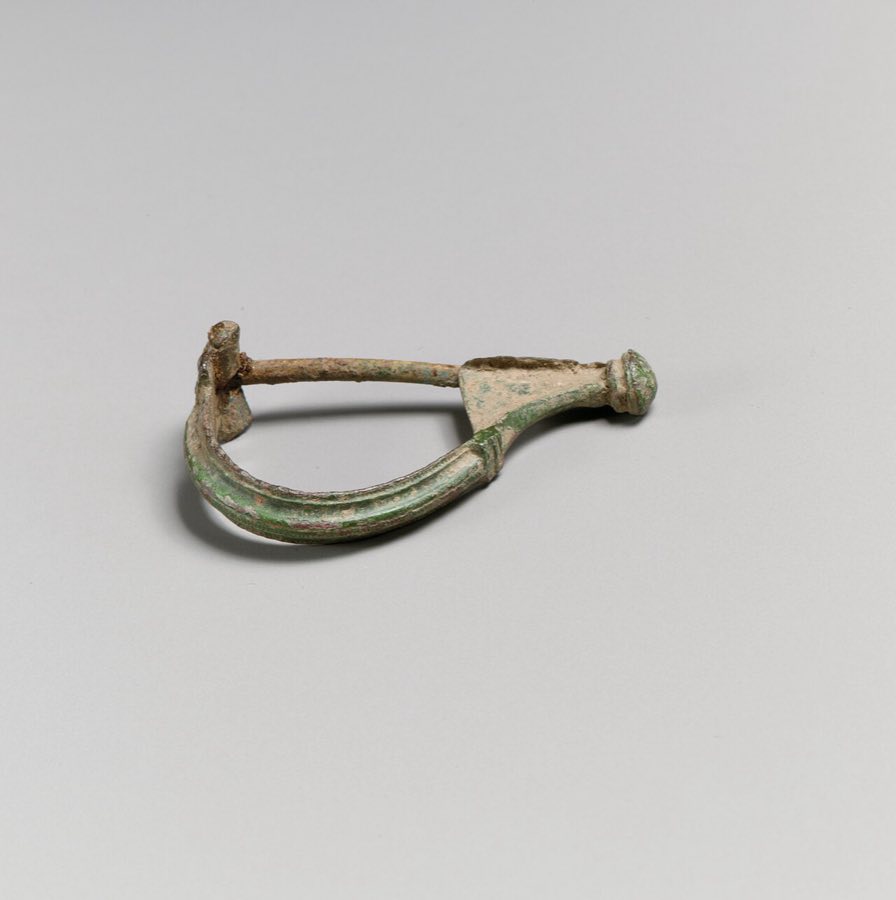

Brooch · Roman Empire
Aucissa fibula
20 BCE–70 CE, Roman
The Aucissa is the classic brooch of the Augustan to early Flavian army, made in northern Italy and Gaul and carried to every frontier from Judaea to Britain, where it marks the Claudian conquest. Named for the most frequent maker's stamp, it was made in the tens of thousands with several other stamped names. Most examples are 45–60 mm long; those with a legible stamp command a premium.
| Object | Brooch |
|---|---|
| Dates | 20 BCE–70 CE |
| Period | Roman Empire |
| Cultures | Roman |
| Regions | Europe — Western & Central, Europe — Mediterranean, Europe — Northern & British Isles |
Diagnostic traits
A bronze brooch with a high semicircular ribbed bow, a hinged pin held in a rolled-over head plate, a short foot ending in a knob, and often the maker's name AVCISSA stamped on the head.
Identification
The hinged pin and rolled-over head plate separate it from all spring brooches; the Hod Hill brooch, its successor, has a flatter bow with cast decoration and lugs on the sides. Late La Tène brooches have a spring and an open catchplate. Gilded or tinned examples exist but silver ones are rare.
Reproductions and fakes
Aucissa brooches are reproduced by casting from originals, giving a soft ribbed bow, a fuzzy stamp and no wear on the hinge; a genuine hinge pin is iron or bronze and usually corroded or missing, and the bow ribs show wear at the crest. Watch for excavated brooches with modern replacement pins.
Elsewhere
- Wikidata: Q758628
Cite this article
Stratum Strata. "Aucissa fibula" (Artifact type). Stratum Strata pack 2026.09, as of 2026-09-21. https://stratum.black/strata/types/aucissa-fibula. Accessed 2026-09-21.
@misc{stratum-aucissa-fibula,
  title        = {Aucissa fibula},
  author       = {{Stratum Strata}},
  howpublished = {\url{https://stratum.black/strata/types/aucissa-fibula}},
  year         = {2026},
  note         = {Artifact type article, Stratum Strata pack 2026.09, as of 2026-09-21; sources: stratum, wikidata, commons. Accessed 2026-09-21.}
}
Citations carry the pack version and the article's as-of date so they resolve to the same text later. The facts themselves belong to the sources listed below; cite those for the science.