
Site · Mexico
Teotihuacan
Teotihuacan, 100–650 CE
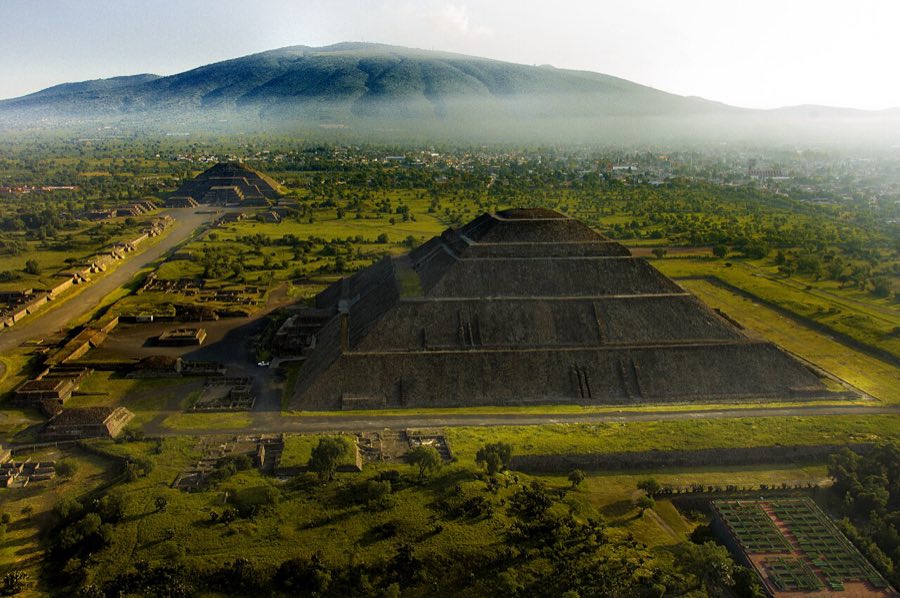
Teotihuacan was the largest city of the Classic Americas, with the Pyramids of the Sun and Moon on the Avenue of the Dead, occupied from about 100 BCE and at its peak from 100 to 650 CE. It lies northeast of Mexico City and is the most visited archaeological site in Mexico.
| Country | Mexico |
|---|---|
| State / province | State of Mexico |
| Dates | 100–650 CE |
| Status | Archaeological zone and UNESCO World Heritage Site |
| Managed by | Instituto Nacional de Antropología e Historia (INAH) |
| Access | Open to the public with museums and the Avenue of the Dead |
| Coordinates | 19.692, -98.844 (public site) |
What was found
Excavations in the Pyramid of the Moon, the Feathered Serpent Pyramid and the apartment compounds recovered sacrificial burials with greenstone figures and obsidian, Thin Orange ware, tripod vessels, stone masks, murals and thousands of Pachuca obsidian blades. The tunnel beneath the Feathered Serpent Pyramid, explored since 2003, held tens of thousands of offerings.
Rules
Nothing may be collected, dug, moved or removed at Teotihuacan; it is a protected archaeological site managed by Instituto Nacional de Antropología e Historia (INAH), and taking artifacts, stones or samples is an offence. All pre-Hispanic remains are property of the Mexican nation under the 1972 federal monuments law, and export is prohibited. This article is for study and context only and is not a collecting locality.
Elsewhere
Cite this article
Stratum Strata. "Teotihuacan" (Site). Stratum Strata pack 2026.09, as of 2026-09-21. https://stratum.black/strata/sites/teotihuacan. Accessed 2026-09-21.
@misc{stratum-teotihuacan,
  title        = {Teotihuacan},
  author       = {{Stratum Strata}},
  howpublished = {\url{https://stratum.black/strata/sites/teotihuacan}},
  year         = {2026},
  note         = {Site article, Stratum Strata pack 2026.09, as of 2026-09-21; sources: stratum, wikidata, commons. Accessed 2026-09-21.}
}
Citations carry the pack version and the article's as-of date so they resolve to the same text later. The facts themselves belong to the sources listed below; cite those for the science.