
Site · United Kingdom
Sutton Hoo
Anglo-Saxon, 590–650 CE
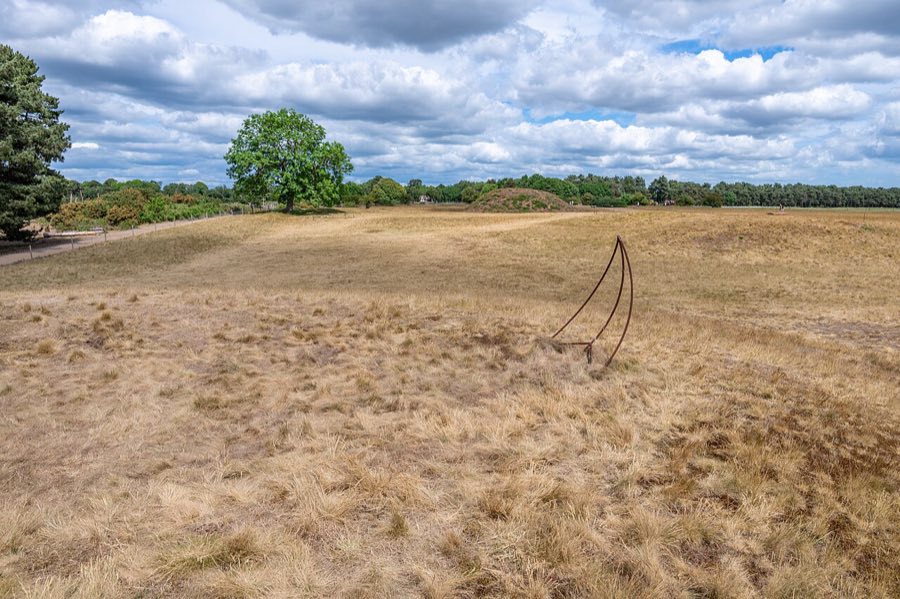
Sutton Hoo is the seventh-century Anglo-Saxon royal cemetery above the Deben estuary near Woodbridge, where a 27-metre ship burial, probably of King Rædwald, was excavated in 1939. It is the richest early medieval burial in Britain.
| Country | United Kingdom |
|---|---|
| State / province | Suffolk |
| Dates | 590–650 CE |
| Status | Scheduled Monument |
| Managed by | National Trust |
| Access | Open to the public with an exhibition hall and viewing tower over the mounds |
| Coordinates | 52.089, 1.338 (public site) |
What was found
The 1939 Mound 1 ship burial contained the helmet, shoulder clasps, great gold buckle, sword, shield, Byzantine silver, Merovingian coins and lyre now in the British Museum. Later excavations found the Mound 17 horse burial and execution cemetery.
Rules
Nothing may be collected, dug, moved or removed at Sutton Hoo; it is a protected archaeological site managed by National Trust, and taking artifacts, stones or samples is an offence. In England, Scheduled Monument protection makes any digging or metal detecting without consent an offence. This article is for study and context only and is not a collecting locality.
Elsewhere
Cite this article
Stratum Strata. "Sutton Hoo" (Site). Stratum Strata pack 2026.09, as of 2026-09-21. https://stratum.black/strata/sites/sutton-hoo. Accessed 2026-09-21.
@misc{stratum-sutton-hoo,
  title        = {Sutton Hoo},
  author       = {{Stratum Strata}},
  howpublished = {\url{https://stratum.black/strata/sites/sutton-hoo}},
  year         = {2026},
  note         = {Site article, Stratum Strata pack 2026.09, as of 2026-09-21; sources: stratum, wikidata, commons. Accessed 2026-09-21.}
}
Citations carry the pack version and the article's as-of date so they resolve to the same text later. The facts themselves belong to the sources listed below; cite those for the science.