
Site · United Kingdom
Skara Brae
3180–2500 BCE
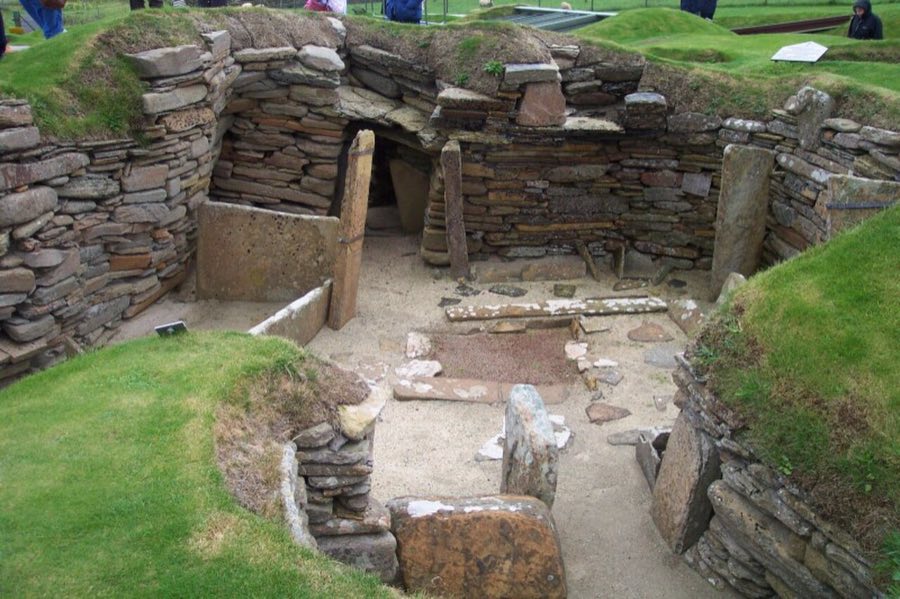
Skara Brae is the best-preserved Neolithic village in northern Europe, eight stone houses linked by covered passages on the Bay of Skaill in Orkney, occupied from about 3180 to 2500 BCE and revealed by a storm in 1850. It forms part of the Heart of Neolithic Orkney World Heritage site with Maes Howe and the Ring of Brodgar.
| Country | United Kingdom |
|---|---|
| State / province | Orkney, Scotland |
| Dates | 3180–2500 BCE |
| Status | Scheduled Monument and UNESCO World Heritage Site |
| Managed by | Historic Environment Scotland |
| Access | Open to the public with a visitor centre and replica house |
| Coordinates | 59.049, -3.343 (public site) |
What was found
Excavations recovered Grooved Ware pottery, carved stone balls, bone beads and pins, whalebone tools, stone furniture including dressers and box beds, and midden deposits rich in shell and animal bone. Finds are displayed in the visitor centre and in Stromness and Edinburgh.
Rules
Nothing may be collected, dug, moved or removed at Skara Brae; it is a protected archaeological site managed by Historic Environment Scotland, and taking artifacts, stones or samples is an offence. Scottish law treats all archaeological finds as Crown property under bona vacantia and Treasure Trove, and the site is a Scheduled Monument. This article is for study and context only and is not a collecting locality.
Elsewhere
Cite this article
Stratum Strata. "Skara Brae" (Site). Stratum Strata pack 2026.09, as of 2026-09-21. https://stratum.black/strata/sites/skara-brae. Accessed 2026-09-21.
@misc{stratum-skara-brae,
  title        = {Skara Brae},
  author       = {{Stratum Strata}},
  howpublished = {\url{https://stratum.black/strata/sites/skara-brae}},
  year         = {2026},
  note         = {Site article, Stratum Strata pack 2026.09, as of 2026-09-21; sources: stratum, wikidata, commons. Accessed 2026-09-21.}
}
Citations carry the pack version and the article's as-of date so they resolve to the same text later. The facts themselves belong to the sources listed below; cite those for the science.