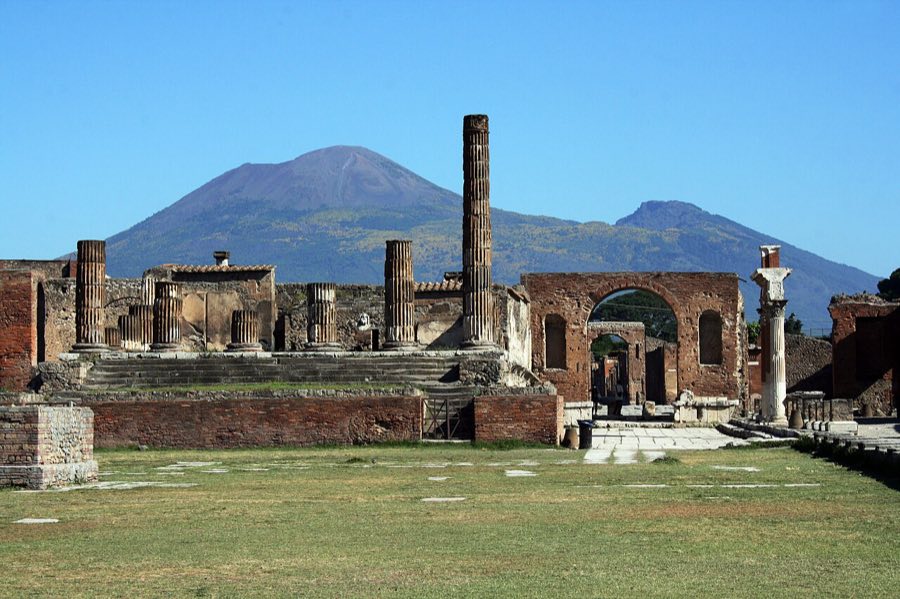

Site · Italy
Pompeii
Roman, 600 BCE–79 CE
Pompeii is the Roman town buried by Vesuvius in 79 CE and excavated continuously since the eighteenth century, preserving streets, houses and public buildings as they stood. It is the most complete picture of an ancient city anywhere.
| Country | Italy |
|---|---|
| State / province | Campania |
| Dates | 600 BCE–79 CE |
| Status | Archaeological park and UNESCO World Heritage Site |
| Managed by | Parco Archeologico di Pompei, Ministero della Cultura |
| Access | Open to the public with houses, forum, amphitheatre and villas |
| Coordinates | 40.751, 14.487 (public site) |
What was found
Excavations since 1748 have recovered frescoes, mosaics, bronze statuary, silver services, carbonised food, surgical instruments, graffiti, lamps, amphorae, coins and the plaster casts of victims of the eruption of 79 CE. Most portable finds are in the National Archaeological Museum in Naples.
Rules
Nothing may be collected, dug, moved or removed at Pompeii; it is a protected archaeological site managed by Parco Archeologico di Pompei, Ministero della Cultura, and taking artifacts, stones or samples is an offence. Italian law vests all archaeological finds in the state, and removal or export is a crime. Visitors removing even a fragment of plaster or mosaic are prosecuted. This article is for study and context only and is not a collecting locality.
Elsewhere
Cite this article
Stratum Strata. "Pompeii" (Site). Stratum Strata pack 2026.09, as of 2026-09-21. https://stratum.black/strata/sites/pompeii. Accessed 2026-09-21.
@misc{stratum-pompeii,
  title        = {Pompeii},
  author       = {{Stratum Strata}},
  howpublished = {\url{https://stratum.black/strata/sites/pompeii}},
  year         = {2026},
  note         = {Site article, Stratum Strata pack 2026.09, as of 2026-09-21; sources: stratum, wikidata, commons. Accessed 2026-09-21.}
}
Citations carry the pack version and the article's as-of date so they resolve to the same text later. The facts themselves belong to the sources listed below; cite those for the science.