
Site · Greece
Mycenae
1600–1100 BCE
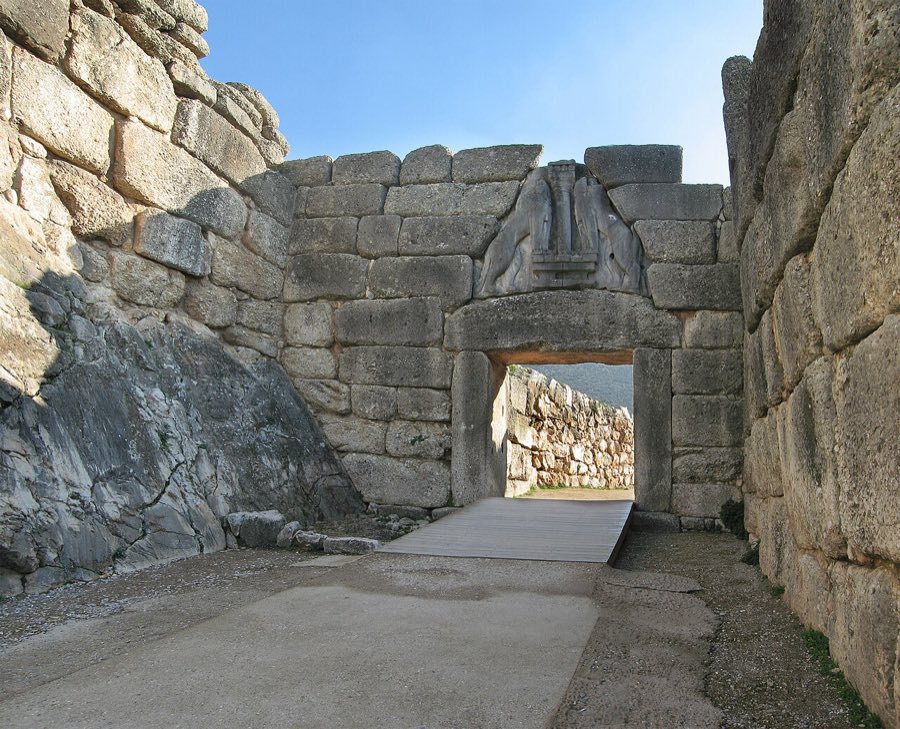
Mycenae is the citadel in the Argolid that gives its name to Late Bronze Age Greece, fortified with cyclopean walls and the Lion Gate around 1350 BCE and destroyed about 1100. Its shaft graves, excavated in 1876, revealed the wealth of Homer's kings.
| Country | Greece |
|---|---|
| State / province | Peloponnese |
| Dates | 1600–1100 BCE |
| Status | Archaeological site and UNESCO World Heritage Site |
| Managed by | Hellenic Ministry of Culture, Ephorate of Antiquities of Argolid |
| Access | Open to the public with a site museum |
| Coordinates | 37.731, 22.756 (public site) |
What was found
Schliemann's Grave Circle A yielded the gold death masks, diadems, inlaid daggers and cups. Later work found Grave Circle B, the Treasury of Atreus, Linear B tablets, ivories and the Lion Gate.
Rules
Nothing may be collected, dug, moved or removed at Mycenae; it is a protected archaeological site managed by Hellenic Ministry of Culture, Ephorate of Antiquities of Argolid, and taking artifacts, stones or samples is an offence. Greek law vests all antiquities in the state, and removal or export is a crime. This article is for study and context only and is not a collecting locality.
Elsewhere
Cite this article
Stratum Strata. "Mycenae" (Site). Stratum Strata pack 2026.09, as of 2026-09-21. https://stratum.black/strata/sites/mycenae. Accessed 2026-09-21.
@misc{stratum-mycenae,
  title        = {Mycenae},
  author       = {{Stratum Strata}},
  howpublished = {\url{https://stratum.black/strata/sites/mycenae}},
  year         = {2026},
  note         = {Site article, Stratum Strata pack 2026.09, as of 2026-09-21; sources: stratum, wikidata, commons. Accessed 2026-09-21.}
}
Citations carry the pack version and the article's as-of date so they resolve to the same text later. The facts themselves belong to the sources listed below; cite those for the science.