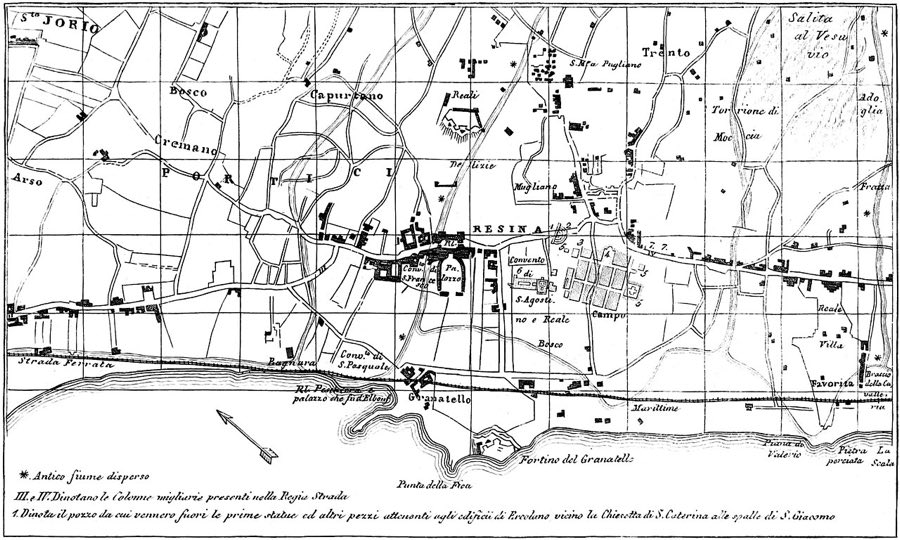

Site · Italy
Herculaneum
Roman, 600 BCE–79 CE
Herculaneum is the seaside Roman town buried under twenty metres of volcanic material by Vesuvius in 79 CE, smaller than Pompeii but better preserved in wood and organic remains. Excavation began by tunnelling in 1738.
| Country | Italy |
|---|---|
| State / province | Campania |
| Dates | 600 BCE–79 CE |
| Status | Archaeological park and UNESCO World Heritage Site |
| Managed by | Parco Archeologico di Ercolano, Ministero della Cultura |
| Access | Open to the public; the Villa of the Papyri is partly excavated |
| Coordinates | 40.806, 14.348 (public site) |
What was found
The pyroclastic burial preserved wooden furniture, doors, boats, food, the carbonised scrolls of the Villa of the Papyri, bronzes, frescoes and the skeletons of hundreds of refugees in the boat sheds. The scrolls are being read with X-ray imaging in Naples and abroad.
Rules
Nothing may be collected, dug, moved or removed at Herculaneum; it is a protected archaeological site managed by Parco Archeologico di Ercolano, Ministero della Cultura, and taking artifacts, stones or samples is an offence. Italian law vests all archaeological finds in the state, and removal or export is a crime. This article is for study and context only and is not a collecting locality.
Elsewhere
Cite this article
Stratum Strata. "Herculaneum" (Site). Stratum Strata pack 2026.09, as of 2026-09-21. https://stratum.black/strata/sites/herculaneum. Accessed 2026-09-21.
@misc{stratum-herculaneum,
  title        = {Herculaneum},
  author       = {{Stratum Strata}},
  howpublished = {\url{https://stratum.black/strata/sites/herculaneum}},
  year         = {2026},
  note         = {Site article, Stratum Strata pack 2026.09, as of 2026-09-21; sources: stratum, commons. Accessed 2026-09-21.}
}
Citations carry the pack version and the article's as-of date so they resolve to the same text later. The facts themselves belong to the sources listed below; cite those for the science.