
Site · Peru
Chavín de Huántar
Chavín, 1200–500 BCE
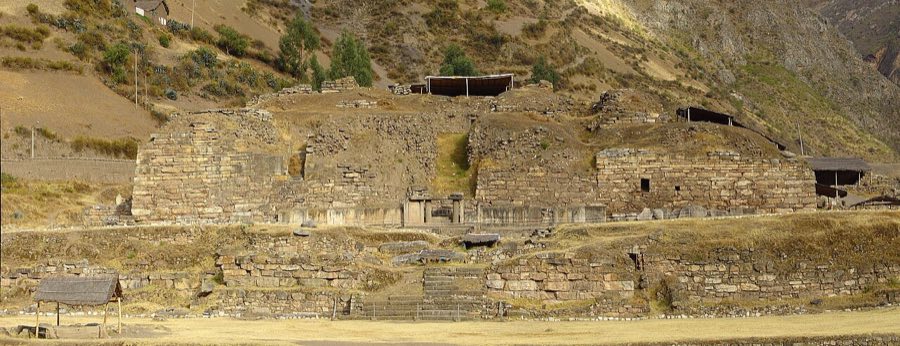
Chavín de Huántar, at 3,180 m in the Callejón de Conchucos, was the ceremonial centre whose art style spread across Peru in the Early Horizon, with stone galleries, water channels engineered for sound and a cult of fanged deities. The Old Temple dates from about 1200 BCE and the New Temple with the Black and White Portal from about 800 BCE; the site declined around 500 BCE.
| Country | Peru |
|---|---|
| Dates | 1200–500 BCE |
| Status | National Archaeological Monument and UNESCO World Heritage Site (1985) |
| Managed by | Ministerio de Cultura del Perú |
| Access | Open daily with a national museum beside the site in the town of Chavín, reached by road from Huaraz; visitors enter the galleries beneath the Old Temple to see the Lanzón. |
| Coordinates | -9.593, -77.178 (public site) |
What was found
Julio Tello's work in 1919 and later excavations by Lumbreras, Burger and Rick recorded the Lanzón monolith in its gallery, the Tello Obelisk and Raimondi Stone, tenon heads on the temple walls, the Circular Plaza reliefs, pututu conch trumpets and Chavín-style pottery and carved bone.
Rules
Nothing may be collected; Peru's Law 28296 on the National Cultural Heritage applies, all pre-Columbian objects are national property and export is prohibited. This article is for study and context only and is not a collecting locality.
Elsewhere
Cite this article
Stratum Strata. "Chavín de Huántar" (Site). Stratum Strata pack 2026.09, as of 2026-09-21. https://stratum.black/strata/sites/chavin-de-huantar. Accessed 2026-09-21.
@misc{stratum-chavin-de-huantar,
  title        = {Chavín de Huántar},
  author       = {{Stratum Strata}},
  howpublished = {\url{https://stratum.black/strata/sites/chavin-de-huantar}},
  year         = {2026},
  note         = {Site article, Stratum Strata pack 2026.09, as of 2026-09-21; sources: stratum, wikidata, commons. Accessed 2026-09-21.}
}
Citations carry the pack version and the article's as-of date so they resolve to the same text later. The facts themselves belong to the sources listed below; cite those for the science.