
Site · United States
Chaco Canyon
Ancestral Puebloan, 850–1250 CE
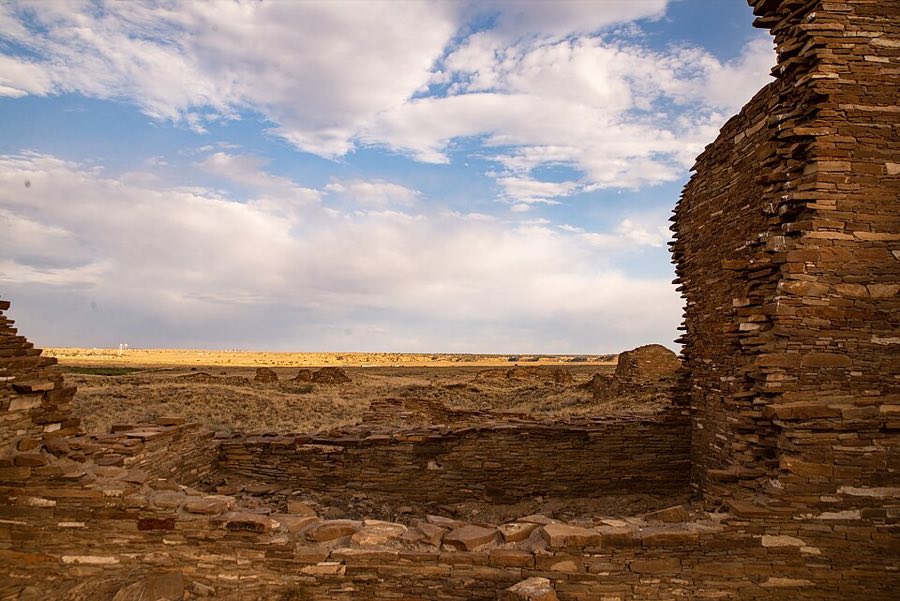
Chaco Canyon was the centre of the Ancestral Puebloan world between about 850 and 1150, with a dozen great houses such as Pueblo Bonito, great kivas, roads and astronomical alignments. It sits in a remote canyon of northwestern New Mexico and is a World Heritage and International Dark Sky site.
| Country | United States |
|---|---|
| State / province | New Mexico |
| Dates | 850–1250 CE |
| Status | National Historical Park and UNESCO World Heritage Site |
| Managed by | National Park Service |
| Access | Open to the public with self-guided trails through the great houses |
| Coordinates | 36.061, -107.962 (public site) |
What was found
Pueblo Bonito yielded tens of thousands of turquoise pieces, cylinder jars with cacao residue, macaw skeletons, shell trumpets, copper bells from Mexico, Chaco black-on-white pottery and wooden ceremonial staffs. Room 33 held elite burials with turquoise mosaics.
Rules
Nothing may be collected, dug, moved or removed at Chaco Canyon; it is a protected archaeological site managed by National Park Service, and taking artifacts, stones or samples is an offence. Federal, state and tribal law, including ARPA and NAGPRA where applicable, protect the site and its burials. Chaco is a World Heritage property and the Pueblo and Navajo nations regard it as sacred. This article is for study and context only and is not a collecting locality.
Elsewhere
Cite this article
Stratum Strata. "Chaco Canyon" (Site). Stratum Strata pack 2026.09, as of 2026-09-21. https://stratum.black/strata/sites/chaco-canyon. Accessed 2026-09-21.
@misc{stratum-chaco-canyon,
  title        = {Chaco Canyon},
  author       = {{Stratum Strata}},
  howpublished = {\url{https://stratum.black/strata/sites/chaco-canyon}},
  year         = {2026},
  note         = {Site article, Stratum Strata pack 2026.09, as of 2026-09-21; sources: stratum, commons. Accessed 2026-09-21.}
}
Citations carry the pack version and the article's as-of date so they resolve to the same text later. The facts themselves belong to the sources listed below; cite those for the science.