
Site · France
Carnac
4500–3300 BCE
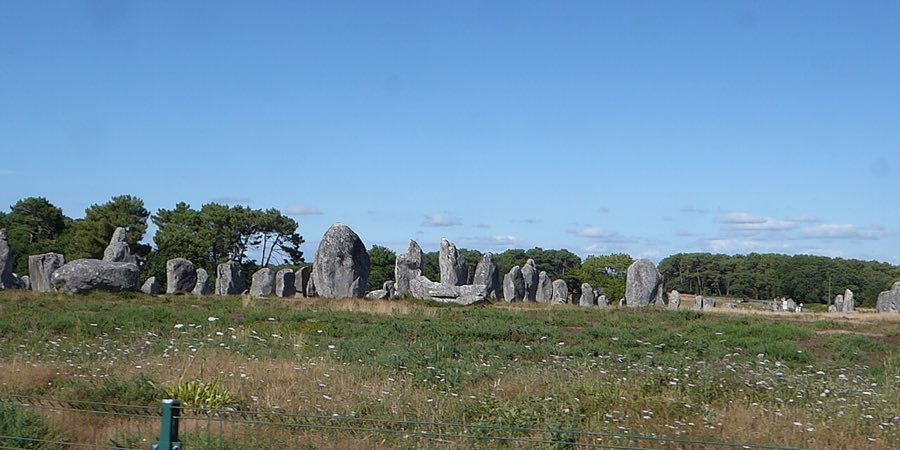
Carnac is the largest group of standing stones in the world, over three thousand menhirs in rows at Ménec, Kermario and Kerlescan in southern Brittany, erected between about 4500 and 3300 BCE. The purpose remains debated.
| Country | France |
|---|---|
| State / province | Brittany |
| Dates | 4500–3300 BCE |
| Status | Monument historique |
| Managed by | Centre des monuments nationaux |
| Access | Open to the public; the alignments are fenced with guided access in summer |
| Coordinates | 47.593, -3.079 (public site) |
What was found
Excavations around the alignments and the tumulus of Saint-Michel recovered polished axes in jadeitite and fibrolite, variscite beads, Neolithic pottery and cremations. The Kercado passage grave is among the oldest in Europe.
Rules
Nothing may be collected, dug, moved or removed at Carnac; it is a protected archaeological site managed by Centre des monuments nationaux, and taking artifacts, stones or samples is an offence. French law protects the monument and its subsoil, and archaeological finds belong to the state. This article is for study and context only and is not a collecting locality.
Elsewhere
Cite this article
Stratum Strata. "Carnac" (Site). Stratum Strata pack 2026.09, as of 2026-09-21. https://stratum.black/strata/sites/carnac. Accessed 2026-09-21.
@misc{stratum-carnac,
  title        = {Carnac},
  author       = {{Stratum Strata}},
  howpublished = {\url{https://stratum.black/strata/sites/carnac}},
  year         = {2026},
  note         = {Site article, Stratum Strata pack 2026.09, as of 2026-09-21; sources: stratum, commons. Accessed 2026-09-21.}
}
Citations carry the pack version and the article's as-of date so they resolve to the same text later. The facts themselves belong to the sources listed below; cite those for the science.