
Site · United States
Cahokia Mounds
Cahokia, Mississippian, 1050–1350 CE
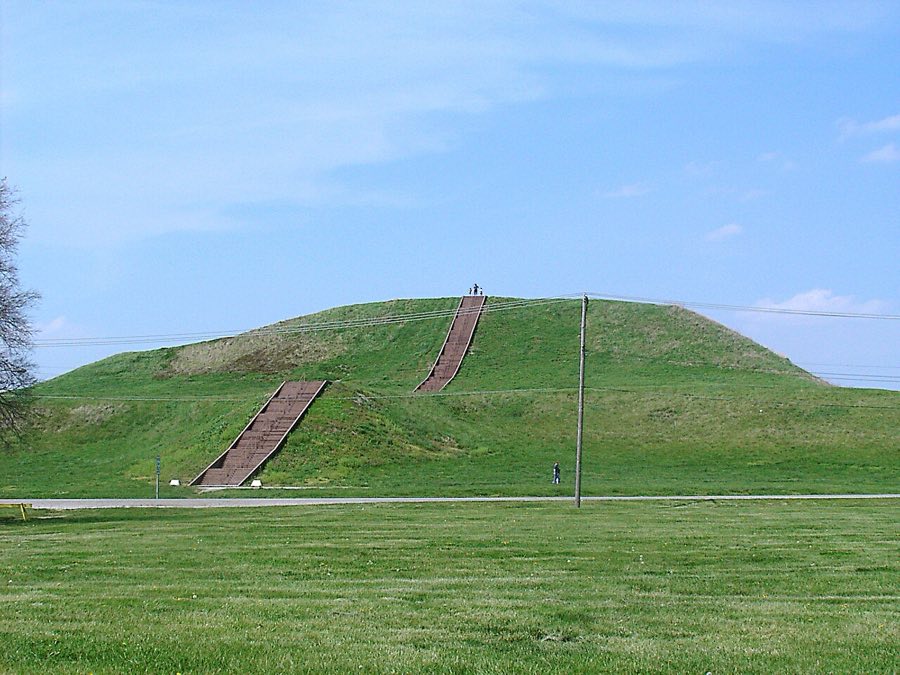
Cahokia was the largest city north of Mexico, with over a hundred mounds, a grand plaza and Monks Mound, the largest earthen structure in the Americas. It rose rapidly around 1050 and declined by 1350. The site sits across the river from St. Louis and is the reference point for all Mississippian archaeology.
| Country | United States |
|---|---|
| State / province | Illinois |
| Dates | 1050–1350 CE |
| Status | State Historic Site and UNESCO World Heritage Site |
| Managed by | Illinois Department of Natural Resources |
| Access | Open to the public with an interpretive centre, trails and Monks Mound |
| Coordinates | 38.655, -90.062 (public site) |
What was found
Excavations recovered Ramey Incised and Powell Plain pottery, Cahokia side-notched points in caches, chunkey stones, Mill Creek chert hoes, flint-clay figurines, copper and shell, and the Mound 72 burials with their thousands of shell beads and arrowpoints. Woodhenge post circles were traced in the soil.
Rules
Nothing may be collected, dug, moved or removed at Cahokia Mounds; it is a protected archaeological site managed by Illinois Department of Natural Resources, and taking artifacts, stones or samples is an offence. Federal, state and tribal law, including ARPA and NAGPRA where applicable, protect the site and its burials. Cahokia is a National Historic Landmark and World Heritage property. This article is for study and context only and is not a collecting locality.
Elsewhere
Cite this article
Stratum Strata. "Cahokia Mounds" (Site). Stratum Strata pack 2026.09, as of 2026-09-21. https://stratum.black/strata/sites/cahokia-mounds. Accessed 2026-09-21.
@misc{stratum-cahokia-mounds,
  title        = {Cahokia Mounds},
  author       = {{Stratum Strata}},
  howpublished = {\url{https://stratum.black/strata/sites/cahokia-mounds}},
  year         = {2026},
  note         = {Site article, Stratum Strata pack 2026.09, as of 2026-09-21; sources: stratum, wikidata, commons. Accessed 2026-09-21.}
}
Citations carry the pack version and the article's as-of date so they resolve to the same text later. The facts themselves belong to the sources listed below; cite those for the science.